

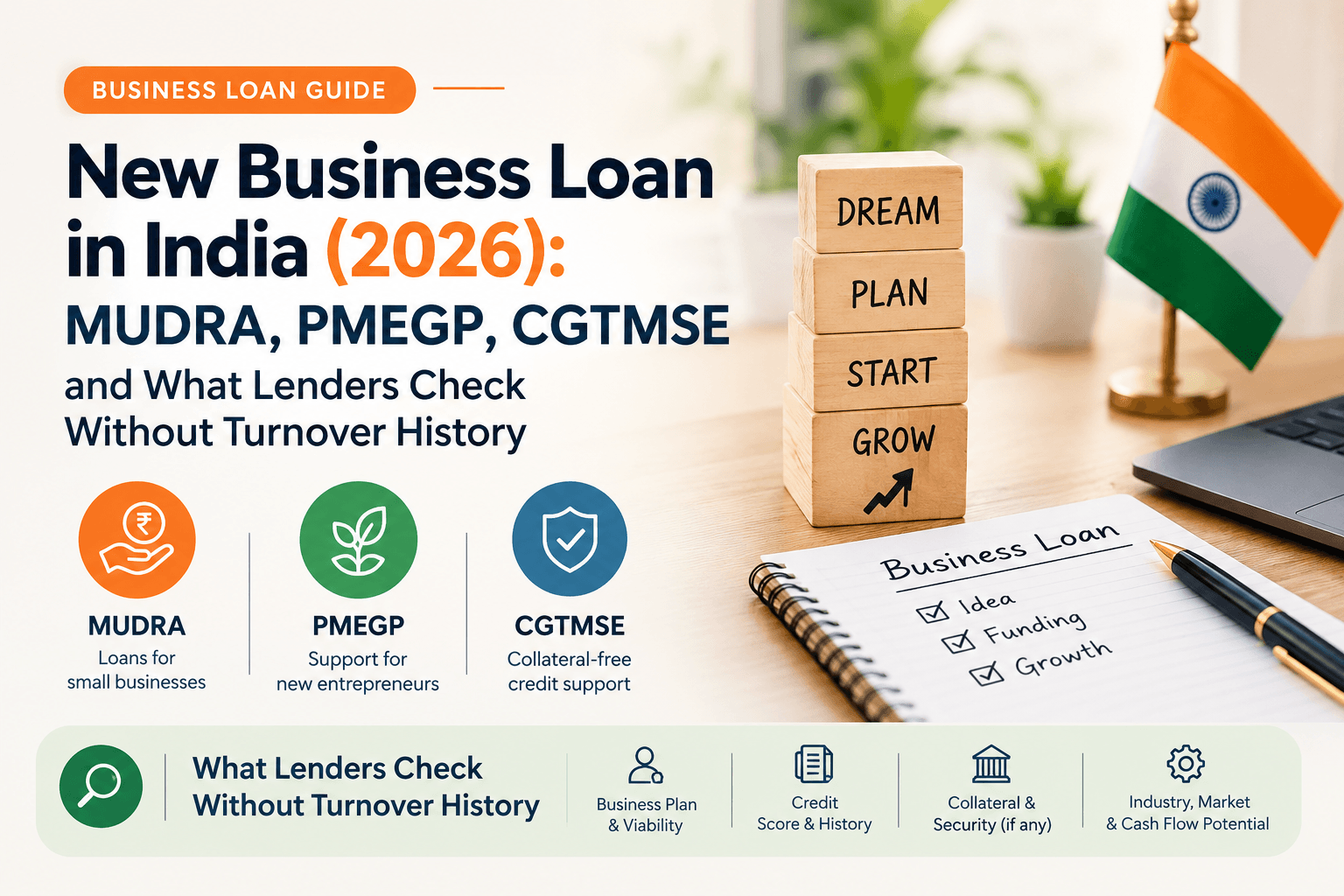
Quick answer: Yes, a new business can get a loan in India, but lenders cannot judge it on past turnover, profit or tax returns. They lean on other evidence: the owner's credit record, a realistic project plan, your own contribution, and the security or guarantee available. The main routes in 2026 are PM MUDRA loans (collateral-free up to ₹20 lakh), the PMEGP credit-linked subsidy for new micro units, bank term loans backed by a CGTMSE credit guarantee, and secured loans where you can offer property or equipment. Approval is never guaranteed. Eligibility, pricing and documents depend on the lender and your profile.
Last checked against official sources on 23 October 2026. Schemes and lender policies change, so confirm with the scheme portal or your lender before acting. This is general information, not financial advice.
Why a new business is assessed differently
An established business can show turnover in GST returns, income tax returns and bank statements, and lenders can test repayment capacity against that history (our guide to how banks calculate business loan eligibility explains the usual tests). A new business has little or none of that. The lender is underwriting a plan and a person.
Lender's question | An established business shows | A new business shows instead |
|---|---|---|
Can it earn? | Turnover, profit, GST filings | Project report, quotations, any orders or letters of intent |
Can it repay? | Cash flow and debt ratios from past years | Projected cash flow, other income, existing EMIs |
Is the owner reliable? | Years of account conduct | The owner's credit report, repayment record and experience in the field |
What if it fails? | Assets and track record | Collateral, guarantee cover and your own money in the project |
What lenders usually look at
Policies differ, so treat this as a guide and ask each lender early:
The promoter's credit profile: repayment of personal loans and cards, and existing EMIs.
Experience: relevant work history or training in the business you are starting.
A project report: costs, quotations, expected sales and a repayment plan that adds up.
Your own contribution: money you put in shows commitment and reduces the lender's exposure.
Security or guarantee: property, equipment, or a credit guarantee scheme.
Banking conduct from day one: a separate business account with regular, traceable transactions.
Registrations: Udyam registration, GST where it applies, and any licences your activity needs.
Many unsecured business loan products ask for a minimum period in business. That minimum is the lender's choice, so check it before you apply rather than after a rejection.
Your main options in 2026
Option | Best suited to | Key facts | Watch out for |
|---|---|---|---|
PM MUDRA | Small projects by micro and small enterprises | Collateral-free up to ₹20 lakh across four tiers | The ₹10–20 lakh tier is for repeat borrowers |
PMEGP | New micro units in manufacturing or services | Subsidy of 15% to 35% of project cost | New projects only, with project cost limits |
Bank loan with CGTMSE cover | Eligible micro and small enterprises without collateral | Guarantee for credit up to ₹10 crore | Guarantee protects the lender, not you |
Small MSE loans under RBI's collateral rule | Loans up to ₹20 lakh from banks | Banks cannot take collateral up to ₹20 lakh | Credit checks still apply |
Secured loan (property or equipment) | Larger needs where you can offer security | Often a larger amount or longer tenure | Your asset is at risk if repayment fails |
PM MUDRA
MUDRA loans come in four tiers: Shishu (up to ₹50,000), Kishor (above ₹50,000 to ₹5 lakh), Tarun (above ₹5 lakh to ₹10 lakh) and Tarun Plus (above ₹10 lakh to ₹20 lakh). Tarun Plus was introduced in 2024 and is for borrowers who have successfully repaid earlier Tarun loans, so a first-time borrower cannot start at ₹20 lakh. The loans cover activities such as manufacturing, trading and services, and are collateral-free up to ₹20 lakh. They are loans from banks and other lending institutions, not grants, and the lender sets the rate and sanctions the amount.
PMEGP
The Prime Minister's Employment Generation Programme (PMEGP) is a credit-linked subsidy for setting up new micro enterprises. The subsidy is 15% to 35% of the project cost. The maximum project cost eligible for the subsidy is ₹50 lakh for manufacturing and ₹20 lakh for business or service activities. For general-category applicants the subsidy is 15% in urban areas and 25% in rural areas. For special categories such as SC, ST, women and some others it is 25% in urban and 35% in rural areas. The balance of the project cost is provided by the bank.
Key conditions: the scheme is for new projects only, land cost is not part of the project cost, and units that have taken subsidy under another government scheme are not eligible. For projects costing more than ₹10 lakh in manufacturing, or more than ₹5 lakh in business or service, the applicant should have at least Class VIII education.
A bank term loan with a CGTMSE guarantee
The Credit Guarantee Scheme for Micro and Small Enterprises, run through CGTMSE, lets lenders extend credit without collateral or third-party guarantees. Since 1 April 2025 it covers credit support of up to ₹10 crore. Your lender applies for the guarantee after sanctioning the loan, and only member lending institutions can do so. The guarantee protects the lender. You still have to repay, and the lender still decides whether to lend. Ask whether any guarantee-related fee will be charged to you and how much. For more on 2026 schemes, see our guide to MSME credit opportunities.
RBI's collateral-free rule for small MSE loans
Under RBI's Master Direction on MSME lending, as amended on 9 February 2026, banks are mandated not to accept collateral security on loans up to ₹20 lakh to micro and small enterprise units. This applies to loans sanctioned or renewed on or after 1 April 2026. Banks may, on the basis of a good track record and financial position, extend the collateral-free limit up to ₹25 lakh as per their internal policy. This removes the collateral requirement. It does not remove the bank's credit assessment. The same Master Direction sets a ceiling of 14 working days for banks' credit decisions on loans up to ₹25 lakh to MSE units.
Secured options, and starting smaller
If you need more than the schemes above allow and have suitable property, weigh the trade-offs in loan against property vs business loan. If you are buying machinery, see business loans for manufacturing companies. If your need is day-to-day cash flow rather than set-up cost, compare working capital loan vs cash credit vs overdraft. A smaller first facility that you repay on time builds the record that later, larger loans depend on.
A worked example (hypothetical)
A first-time entrepreneur plans a small manufacturing unit in an urban area, with a project cost of ₹10 lakh excluding land. Assume a general-category applicant under PMEGP:
Component | Share | Amount |
|---|---|---|
Your own contribution | 10% | ₹1 lakh |
PMEGP subsidy (urban, general category) | 15% | ₹1.5 lakh |
Bank finance for the balance | 75% | ₹7.5 lakh |
Project cost | 100% | ₹10 lakh |
The bank sanctions the loan first, and the subsidy is routed through the scheme's process. The numbers change with your category, location, project and the lender's decision, so use this only to see how the pieces fit.
Before you apply: a seven-step checklist
Register on Udyam. It is free on the official portal, udyamregistration.gov.in. Aadhaar is required, along with PAN and GSTIN where applicable. Avoid lookalike sites or agents that charge for the same form.
Know your classification. From 1 April 2025, micro means investment up to ₹2.5 crore and turnover up to ₹10 crore. Small means up to ₹25 crore and ₹100 crore. Both limits must be met.
Open a separate business account and route business receipts and payments through it from the start.
Check your own credit report and fix errors or overdue accounts before a lender sees them.
Prepare a short project report: cost break-up, quotations, expected sales and monthly repayment capacity.
Decide your contribution and loan amount. Borrow what your projections support, not the maximum on offer.
Collect documents using our business loan documents checklist, and compare offers using the Key Facts Statement, as explained in RBI digital lending rules.
Mistakes to avoid
Paying someone to arrange a government loan or Udyam registration. Promises of guaranteed approval are a red flag.
Applying to many lenders at once. Repeated applications can create unnecessary credit enquiries.
Inflating projections. Lenders test the numbers against quotations and your cash flow.
Mixing personal and business money. It makes your account harder to read.
Assuming collateral-free means no checks. The lender still reviews credit, the plan and repayment capacity.
Next step
If you are planning a first business loan and want to talk through your project, amount and options, ExpressDhan's team can discuss your requirement. Eligibility, pricing and approval depend on the lender, your profile and verification, and no outcome is guaranteed. You can learn about our services or contact us, or call +91 76199 77199 (Mon–Sat, 9:00 AM–6:30 PM).