

At Express Dhan, we speak to business owners every day, and one situation comes up again and again. The business is doing well. Orders are coming in, customers are loyal, sales are growing. Then the loan application comes back with a short, polite "does not meet our criteria."
It's frustrating, and it's rarely explained properly.
So let's do that here. In this guide, we'll walk you through how banks and NBFCs actually assess business loan eligibility, what the numbers mean, and what you can fix before you apply.
Do All Banks Use the Same Formula?
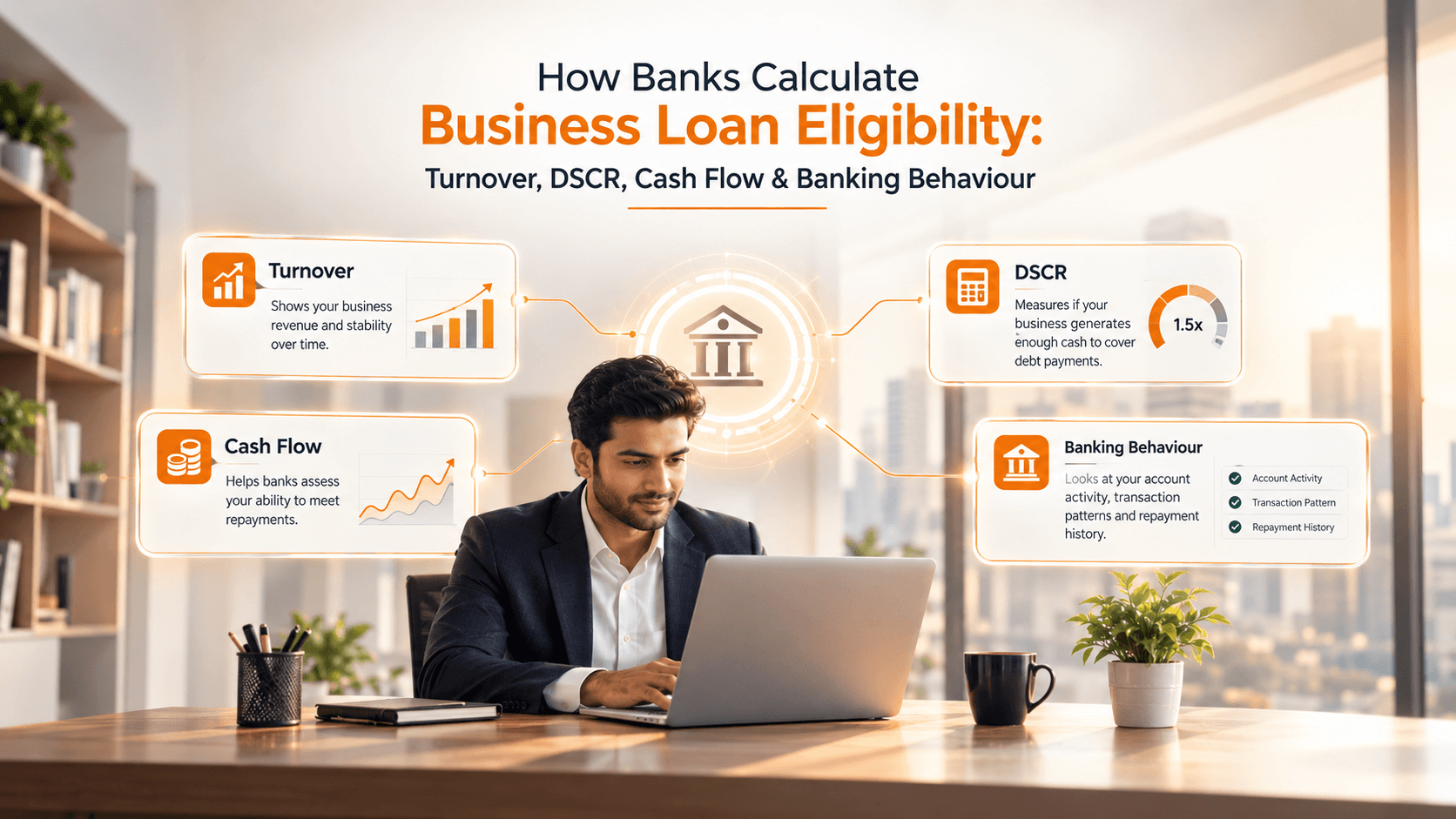
Not exactly. Every lender has its own credit policy, and the weightage they give each factor differs. But almost all of them look at the same core things: your turnover, your ability to repay (DSCR), your cash flow, and how you manage your bank account. Your credit score sits alongside these.
Think of it as a story. Each document you submit is a chapter, and the lender reads all of them together before deciding.
1. Turnover: Where Lenders Start
Turnover is your total sales in a year. It tells the lender how big your business is, and it's usually the first filter.
Lenders read turnover from your GST returns, ITR and financial statements, then cross-check it against your bank statements. When these don't match, it raises questions immediately.
For smaller unsecured loans, many lenders use turnover to estimate how much they can offer. The eligible amount is often a fraction of annual turnover, sometimes in the range of 10% to 30%, but this varies widely by lender, industry and risk profile. Please treat that as a rough guide, not a promise.
Turnover alone doesn't settle things, though. A business with high sales and thin margins can look riskier than a smaller, more profitable one. That's why lenders go further.
2. DSCR: The Number Behind Most Approvals
DSCR, or Debt Service Coverage Ratio, answers one simple question: does your business earn enough to pay all its loan instalments comfortably?
DSCR = Cash available for debt repayment ÷ Total debt repayment due in the year
Cash available is usually net profit plus depreciation plus interest. Total repayment includes principal and interest on all your loans, existing and new.
Here's a simple example. Suppose your business shows a net profit of ₹10 lakh, depreciation of ₹4 lakh and interest of ₹4 lakh. Your cash available is ₹18 lakh.
You already pay ₹8 lakh a year on existing loans. Now you apply for a new ₹15 lakh loan over four years at around 16%, which works out to roughly ₹5.1 lakh a year in EMIs. Your total yearly repayment becomes about ₹13.1 lakh.
DSCR = 18 ÷ 13.1 = about 1.37
DSCR | What it usually signals |
|---|---|
Below 1 | Earnings don't cover debt payments |
1 to 1.25 | Tight, with little room for a slow month |
1.25 to 1.5 | Generally comfortable |
Above 1.5 | Strong repayment cushion |
Many lenders prefer a DSCR of about 1.25 or higher, though thresholds differ. In the example above, a ₹15 lakh loan works. Raise the request to ₹30 lakh and the ratio drops quickly. That is often why an application comes back with a lower amount instead of an outright rejection.
3. Cash Flow: Profit and Cash Are Not the Same Thing
A business can show a profit on paper and still feel short of cash. Customers may be paying late. Money may be tied up in stock. Suppliers may need advance payments.
Lenders understand this, so they look closely at how money actually moves through your account. They want to see regular inflows and a pattern that makes sense for your business.
Seasonality is fine. A festive-season business will naturally have peaks and quiet months. What lenders question is unexplained irregularity, such as a big deposit in one month followed by very little.
Your payment cycle matters too. If your buyers take 60 to 90 days to pay, lenders will consider how you manage the wait.
4. Banking Behaviour: What Your Account Says About You
If turnover and DSCR are the headline, banking behaviour is the fine print. It often tips a borderline application one way or the other.
When a lender reviews six to twelve months of your statements, here's what they notice.
Average balance. Whether you maintain a healthy cushion or drop close to zero every month-end.
Bounced cheques and failed EMIs. Even a few can suggest cash stress or poor discipline.
Overdraft or cash credit usage. Staying at the maximum limit all the time can signal heavy dependence on borrowed money.
Regularity of credits. Steady customer payments build confidence. Large, unexplained credits raise questions.
Cash and digital mix. Heavy cash deposits with little digital trail are harder to verify.
Round-tripping. Money moved in and out between related accounts to inflate turnover is something lenders actively watch for, and it can end an application.
Mismatch with GST. If bank credits are far lower than the sales you've declared, the lender will wonder which figure is accurate.
None of this asks for perfection. It asks for consistency and honesty. A simple, genuine account usually works better than a polished one that doesn't add up.
5. Credit Score and Existing Loans
Lenders also check your CIBIL score, and often the promoters' personal scores as well, since for smaller businesses the owner's credit habits are part of the risk picture. A score of around 700 or above is commonly preferred, though it varies by lender.
They'll also add up your existing obligations, including business loans, personal loans, vehicle loans and credit card dues. This surprises many owners. A personal EMI can reduce how much your business qualifies for.
How Do These Factors Work Together?
Picture the lender's process. Turnover shows whether your business is the right size for the loan. DSCR tests whether it can carry the debt. Cash flow shows whether money actually moves. Banking behaviour shows how you manage it. Credit history adds the background.
A weakness in one area can sometimes be balanced by strength in another. A slightly tight DSCR may be accepted if your banking record is clean and your business is long-established. But several weak areas together usually lead to a decline or a much smaller offer.
Why Do Good Businesses Still Get Rejected?
In our experience, most rejections trace back to fixable issues, not a weak business.
The most common ones are turnover in GST returns not matching the ITR, too many existing loans, recent cheque bounces, a very low average balance, a loan request that's too large for the cash flow, and incomplete documents.
Consider a business owner with steady sales who applies for a ₹25 lakh loan. On review, the statements show three cheque returns in five months and a balance that falls to a few thousand rupees at every month-end. The business is healthy. The account tells a different story. This is exactly the kind of gap that a little preparation can close.
How Can You Improve Your Eligibility Before Applying?
You don't need months of preparation, but a few steps make a real difference.
Make sure your GST returns, ITR and bank statements are consistent with one another. Avoid cheque bounces for at least three to six months before applying. Try to keep a reasonable balance at month-end. Clear small, high-interest debts where possible, since this improves your DSCR. Ask for an amount your cash flow can comfortably support, not the largest figure you could get.
It also helps to calculate your own DSCR first. If you know your numbers before the lender does, you can decide whether to apply now or strengthen your profile first.
How Is Eligibility Assessment Changing?
Lending is becoming more data-driven. Many lenders now use GST data and consent-based bank data, such as through the Account Aggregator framework, to see cash flow directly instead of relying only on paper documents.
For honest, well-run businesses, this is good news. The more consistent and transparent your finances are, the easier they are to verify.
How Express Dhan Can Help
Different lenders weigh these factors differently. One may focus on turnover, another on banking behaviour, another on DSCR. Applying to the wrong lender can lead to a rejection, and repeated applications can affect your credit score.
At Express Dhan, we help you understand where your business stands before you apply. We guide you on documents, help you choose the right loan amount and structure, and match your profile with lenders whose criteria suit your business. Our aim is simple: fewer rejections, faster decisions and less paperwork stress for you.
The Bottom Line
Lenders aren't judging your ambition. They're reading evidence: how much you sell, how comfortably you can repay, how money moves through your business, and how you manage your account.
The encouraging part is that most of this is within your control. Keep your records consistent, protect your banking habits, know your numbers and borrow a sensible amount.
Want to know how eligible your business is before you apply? Talk to Express Dhan today and get clear guidance on the right loan for your business.
Disclaimer: Eligibility criteria, DSCR benchmarks, loan-to-turnover ratios and interest rates vary by lender and are subject to change. Figures in this article are illustrative. Please verify current details with the lender before applying.