

For many manufacturers in India, growing the business can feel less like a business decision and more like a cash-flow puzzle.
Raw material has to be bought before production starts. Wages have to be paid every month. A new machine may cost lakhs, or even crores. And the customer who placed the big order may not pay for another 60 to 90 days.
That is why financing is not a side topic for manufacturers. It is part of how the business runs.
A business loan for manufacturing companies is designed to solve a specific problem: the gap between when a factory spends money and when it earns it.
But not every loan solves every problem. The right product depends on what you are financing.
Why Is Manufacturing Financing Different?
A trading or service business can often start earning quickly. A manufacturer usually cannot.
Money goes out long before it comes back in:
Stage | What it costs |
|---|---|
Setting up | Factory space, power connection, compliance, machinery |
Buying inputs | Raw material, often paid in advance or on short credit |
Producing | Wages, electricity, maintenance, work-in-progress stock |
Selling | Transport, packaging, and then waiting for payment |
Each stage locks up cash.
This is why even a profitable factory can face a cash crunch. The business may be healthy on paper while the bank balance is under pressure.
That distinction matters.
A cash crunch does not always mean a weak business. Sometimes it simply means a growing one.
What Are the Main Types of Business Loans for Manufacturers?
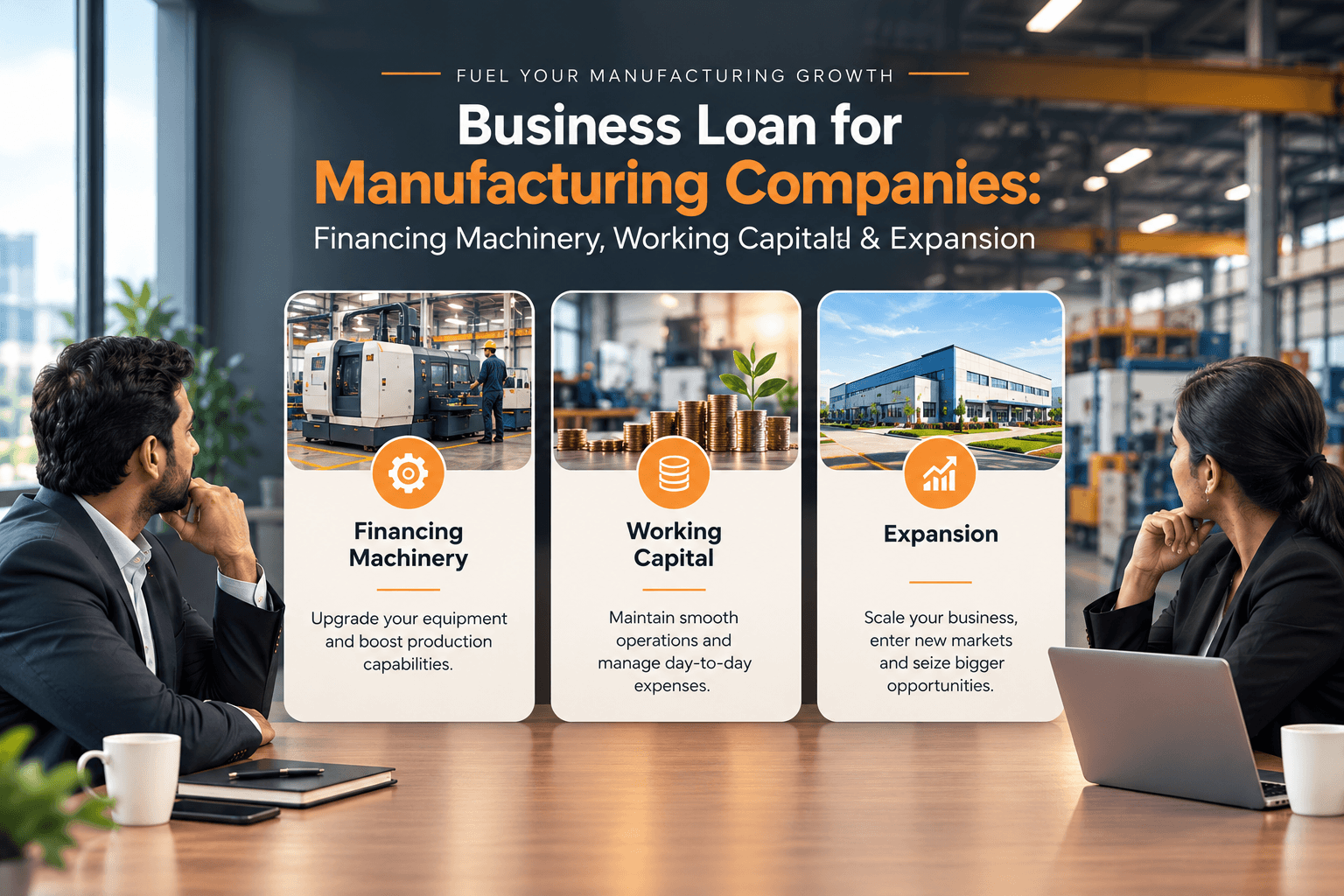
Most manufacturing finance falls into three categories.
Machinery and equipment loans: for buying or upgrading production assets
Working capital loans: for day-to-day operational expenses
Expansion loans: for adding capacity, units or new markets
These are not interchangeable. Using the wrong one is one of the most common financing mistakes.
1. Machinery Loans: Buying Equipment Without Draining Your Cash
Machinery is often the biggest single investment a manufacturer makes.
A machinery loan lets you buy or upgrade equipment while keeping your cash reserves available for running the business.
Common uses include:
CNC machines, lathes, presses and injection molding units
Packaging and assembly lines
Automation to improve output and quality
Replacing old machines that cause downtime and wastage
Second-hand machinery, where the lender allows it
Think of it this way. A machine is meant to earn money over many years, so the loan that pays for it should be spread over a comparable period.
How it typically works
The lender may finance a large share of the machine's cost, and you contribute the rest as margin. The machine itself is often the security, which can reduce the need for additional collateral. Terms vary by lender.
The tenure question
A machine that will earn for ten years should not be financed with a repayment schedule that strains your cash flow in year two.
Matching tenure to the machine's useful life is one of the simplest ways to keep repayments comfortable.
2. Working Capital Loans: Keeping the Factory Running
If machinery is the body of a factory, working capital is the blood flow.
It covers the everyday costs that never stop:
Raw material purchases
Salaries and wages
Electricity and utilities
Transport and logistics
Supplier payments
Working capital is especially important when demand rises suddenly. A large purchase order is good news, but fulfilling it may need more raw material and more labor before any payment arrives.
Common structures
Structure | How it works | Best suited for |
|---|---|---|
Working capital term loan | Lump sum repaid in EMIs | A one-time cash requirement |
Overdraft or cash credit | Draw as needed, pay interest on the amount used | Fluctuating monthly needs |
Invoice-based financing | Funds against unpaid invoices | Long buyer payment cycles |
The difference between these options is not just technical. It affects how much interest you pay and how flexible your cash flow remains.
A manufacturer with steady, predictable needs may prefer a term loan. One whose cash needs rise and fall may find an overdraft-style facility more efficient, because interest applies only to the amount actually used.
3. Expansion Loans: Growing Beyond Your Current Capacity
At some point, the current factory is no longer enough.
Orders are coming in. Machines are running at full load. Deliveries are getting tight. This is often the moment an expansion loan enters the conversation.
Expansion funding can support:
Building or extending a factory or warehouse
Setting up a new production line or unit
Entering new markets or launching new products
Upgrading technology, testing or quality systems
Meeting export or certification requirements
Expansion loans are usually assessed more closely than day-to-day working capital, because the lender is backing a plan rather than an ongoing operation.
That makes preparation important. A lender will want to understand why the expansion makes sense and how it will be repaid.
How Does This Look in Real Life?
Consider a simple example.
Rajesh runs a small packaging unit. A large buyer offers a bulk order, but there is a catch: fulfilling it needs a new printing machine and a large purchase of raw material. Payment will come 75 days after delivery.
Rajesh has two separate needs:
A machine. This is a long-term asset, better suited to a machinery loan spread over several years.
Raw material and wages. This is a short-term operational need, better suited to working capital.
If he used a short-term loan to buy the machine, repayments could squeeze his cash flow. If he used up his cash on the machine, he might struggle to pay for raw material.
The lesson is not about one particular loan. It is about matching each need to the right kind of funding.
What Government Schemes Can Help Manufacturing MSMEs?
Many manufacturers in India operate as MSMEs, which may open access to government-backed support.
CGTMSE (Credit Guarantee Fund Trust for Micro and Small Enterprises): provides a credit guarantee that can allow eligible MSMEs to access loans without collateral
MUDRA Yojana: supports loans for micro and small enterprises
Subsidy and interest-support schemes: these exist for certain sectors and purposes, but terms change over time
Two important points:
First, scheme availability, limits and eligibility can change, so always verify current details with the lender or the official source.
Second, Udyam registration matters. Many lenders and schemes rely on it to confirm your MSME status.
What Do Lenders Look At Before Approving a Manufacturing Loan?
Every lender has its own policy, but the main checks are fairly consistent.
Factor | What lenders usually look for |
|---|---|
Business vintage | Commonly 1 to 3 years of operation |
Turnover | Consistent annual revenue |
Credit profile | A healthy score for the business and promoters, often 700 or above |
Banking behavior | Regular inflows, no frequent bounced cheques or EMI delays |
Compliance | GST returns, ITRs and registrations in order |
Purpose | A clear reason for borrowing |
Repayment capacity | Ability to service the EMI from business cash flow |
None of these is a guarantee on its own.
A strong credit score does not automatically mean approval, and a lower score does not always mean rejection. Lenders weigh the overall picture.
What Documents Are Usually Required?
Documentation is often where applications slow down.
Core documents
PAN and Aadhaar of the business and promoters
Business registration proof (Udyam, GST certificate, partnership deed or incorporation documents)
6 to 12 months of bank statements
ITRs and financial statements for the last 2 to 3 years
GST returns
Purpose-specific documents
Machinery quotation or proforma invoice (for equipment loans)
Project report (for expansion loans)
Order copies or invoices (for working capital or invoice-based financing)
Having these ready before applying can reduce back-and-forth requests.
Does a Business Loan Guarantee Growth?
No.
This is one of the most important points to understand.
A loan is a financing tool, not a growth strategy. It can give a business the capacity to grow, but the result depends on how the money is used.
A machine that sits idle because there are no orders will still have an EMI attached to it. Working capital borrowed without a clear cash cycle can simply extend a problem.
Before borrowing, it helps to ask:
Will this money generate more revenue than it costs?
Do I have orders or demand to support the expansion?
Can my cash flow comfortably handle the EMI, even in a slow month?
Am I choosing the right loan for this specific need?
Good financing supports good planning. It cannot replace it.
What Should Manufacturers Check Before Choosing a Loan?
The interest rate matters, but it is only one part of the picture.
Check the total cost
Look at processing fees, documentation charges and any other applicable fees.
Check prepayment terms
If your cash position improves, can you repay early, and at what cost?
Check tenure flexibility
Does the repayment schedule suit your cash cycle?
Check the purpose fit
Is the product actually designed for what you are financing?
Check the lender and process
Understand the terms clearly before signing. If something is unclear, ask.
How Can You Improve Your Chances of Approval?
A few habits make a noticeable difference.
Keep your books clean. Consistent GST filings and ITRs build lender confidence.
Protect your credit score. Pay EMIs and card dues on time.
Borrow what you need. Over-borrowing increases repayment pressure.
Keep banking activity healthy. Regular inflows and no bounced payments help.
Prepare a simple business case. Orders in hand, projected revenue and a repayment plan strengthen an expansion application.
Separate business and personal finances. Clear records make your business easier to assess.
Financial discipline matters even more as lending becomes more data-driven. A business with transparent, consistent records is easier to evaluate.
Where Does Express Dhan Fit In?
Running a factory is already a full-time job.
Finding the right lender, choosing the right loan structure and preparing documents adds another layer of work.
Express Dhan helps simplify that process for manufacturers by:
Understanding your requirement: machinery, working capital or expansion
Matching you with suitable lending options based on your business profile
Guiding you through documentation, so your application is complete the first time
Supporting you through the process, from application to disbursal
The aim is straightforward: less time chasing paperwork, more time running production.
The Bigger Picture: Financing as Part of Growth
Many manufacturers think of a loan as a last resort, something to consider only when cash runs out.
A better view is to treat financing as a planning tool.
The most effective approach usually looks like this:
Identify the need → choose the matching loan → prepare documents → borrow the right amount → repay with discipline
Each step protects the next one.
A manufacturer who plans financing in advance can accept larger orders, negotiate better with suppliers and invest in machinery at the right time, instead of reacting to pressure.
Conclusion
A business loan for manufacturing companies is not a single product. It is a set of tools, each built for a different stage of the business.
Machinery loans help you build production capacity. Working capital loans keep daily operations running smoothly. Expansion loans support the next phase of growth.
The loan itself does not guarantee success. What matters is choosing the right structure, borrowing responsibly and keeping your financial records in order.
For a manufacturer, the practical takeaway is simple: match the loan to the need, plan repayment around your cash cycle, and keep your documents and credit profile ready before you apply.
Ready to fund your next machine, order or expansion? Talk to Express Dhan and explore business loan options built for manufacturing businesses.
Disclaimer: Interest rates, eligibility criteria, fees and scheme benefits vary by lender and are subject to change. Please verify current details before applying