

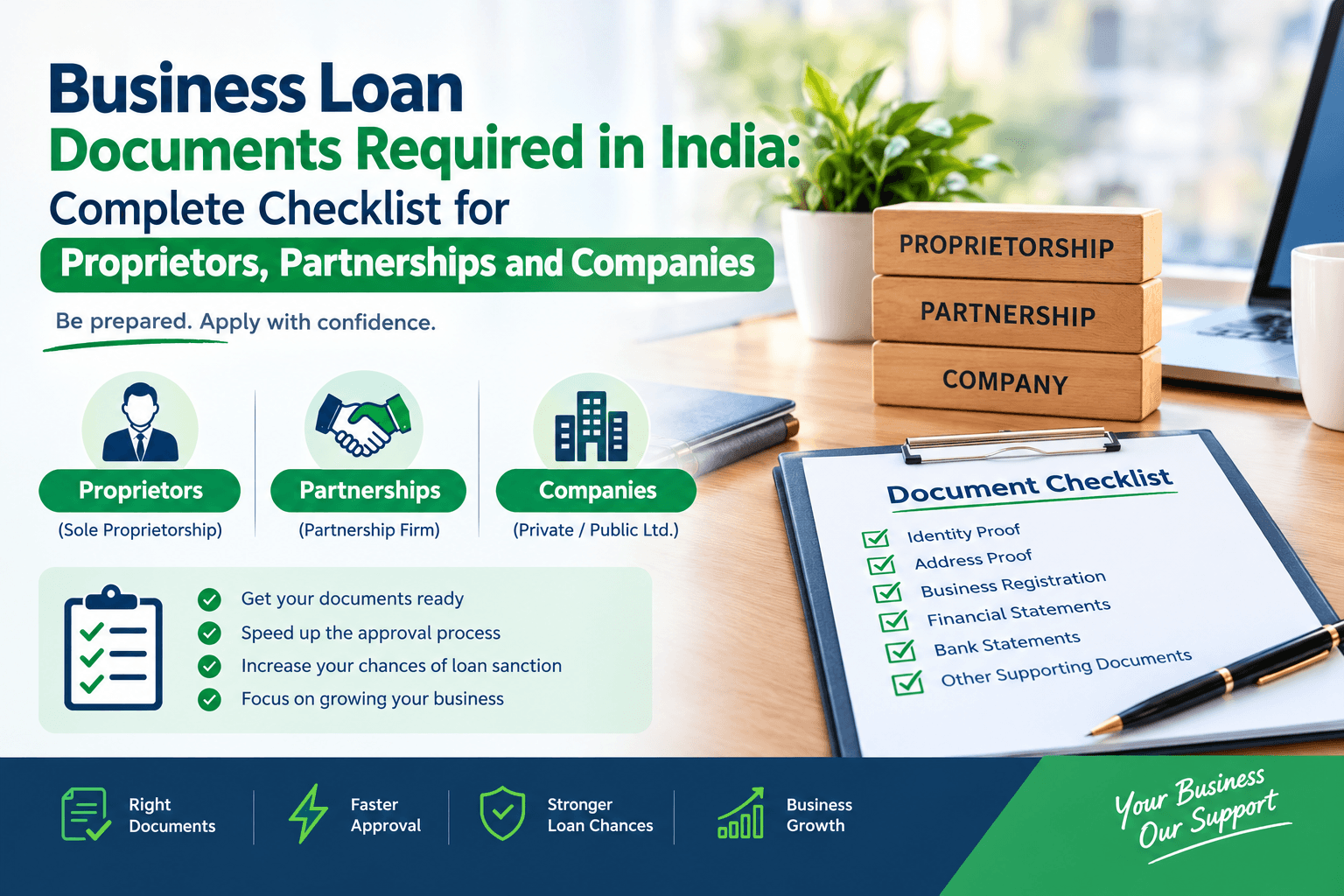
Many business loan applications are not rejected because the business is weak. They are delayed, queried or returned because the file is incomplete, mismatched or unclear.
A lender is not only collecting papers. Each document answers a question:
Who is the borrower?
Does the business really exist and operate?
How much does it earn and how does money move?
Can it repay?
What security supports the loan?
When your documents answer these questions clearly, the process moves faster. If you are still working out how much you can borrow, read our guide on [how banks calculate business loan eligibility] first, then return to this checklist.
The 5 Document Groups Every Lender Looks At
1. KYC and Identity Documents
For the applicant, partners, directors and guarantors:
PAN card
Aadhaar or other valid address proof
Passport-size photographs
Proof of current residence (utility bill, rental agreement)
For a company or LLP, KYC is also needed for authorised signatories and key shareholders.
2. Business Proof
This shows the business is real and legally operating:
GST registration certificate
Udyam registration (important for MSME benefits)
Shop and Establishment licence, trade licence or other applicable licence
Business address proof
Business PAN
Udyam registration also helps you access MSME schemes, including the one covered in our [CGTMSE guide].
3. Financial Documents
This is the core of the credit assessment:
Income Tax Returns for the last 2 to 3 years, with computation of income
Balance sheet and profit and loss statement (CA-certified or audited where applicable)
Provisional financials for the current year, if the year is not closed
Details of existing loans and a repayment track record
4. Banking Documents
Current account statements, usually 6 to 12 months
Statements of all other business or related accounts
Existing loan account statements
Lenders read bank statements for more than the closing balance. They look at inflows, average balance, cheque bounces, cash deposits and repayment discipline. We explained this in detail in our post on [how banks calculate business loan eligibility].
5. GST and Compliance Documents
GST returns (GSTR-3B and GSTR-1), usually for the last 12 months
GST turnover reconciliation with ITR and bank credits
Any other statutory registrations that apply to your business
Mismatch between GST turnover, ITR income and bank inflows is one of the most common reasons for queries.
Documents Required by Business Type
Business type | Extra documents commonly requested |
|---|---|
Sole proprietorship | Proprietorship proof (Udyam, GST, shop licence), proprietor's KYC |
Partnership firm | Partnership deed, firm PAN, partners' KYC, authority letter |
LLP | LLP agreement, certificate of registration, designated partners' KYC |
Private limited company | MOA and AOA, certificate of incorporation, board resolution, shareholding pattern, directors' KYC |
Self-employed professional | Professional registration, ITR, qualification and practice proof |
Documents for Secured Business Loans
If the loan is backed by property or assets, add:
Title deed and chain of property documents
Property tax receipts
Encumbrance certificate
Approved building plan
Valuation report (usually arranged by the lender)
For machinery: quotations and invoices
Compare this route with unsecured borrowing in [Loan Against Property vs Business Loan].
Documents for Larger Loans and Project Funding
For large term loans, expansion or new plants, lenders may also ask for:
Detailed Project Report (DPR)
Projected financial statements and cash flow
Quotations from suppliers
Details of promoter contribution
See our complete guide on [project finance in India] for the full list.
Not sure which documents your lender will ask for? Share your business type and loan amount with an Express Dhan advisor and get a lender-specific checklist. (Talk to Our Advisor]
Why Business Loan Files Get Delayed
Name and address mismatches. The name on PAN, GST, bank account and ITR should match exactly.
Unfiled or late GST returns. Gaps in filing reduce lender confidence.
Turnover mismatch. Turnover in ITR, GST and bank statements should reconcile. If they do not, be ready to explain why.
Low or irregular banking activity. Many owners route money through personal or multiple accounts. Lenders prefer to see business activity in the business account.
Old or unaudited financials. Submitting last year's papers when the current year is far along can raise questions.
Incomplete property documents. For secured loans, missing links in the title chain can hold up legal verification.
How to Prepare Your File Before Applying
Collect all documents in one digital folder, in clear PDF format.
Check every name, spelling and address across documents.
Reconcile GST, ITR and bank statements.
Update your financials up to a recent date.
List all existing loans with outstanding amounts and EMIs.
Check your credit report. Our guide on [how to improve your CIBIL score before a loan] shows what to fix.
Keep a short note explaining any unusual entry, such as a large one-time deposit or a dip in sales.
Faster Applications Through Digital Data
Some lenders can now fetch bank data directly with your consent through the Account Aggregator framework, which reduces manual document submission. Read more in [Account Aggregator and Business Loans]. Even then, lenders may still ask for KYC, business proof and financials.
Printable Checklist
PAN, Aadhaar, photographs
Business registration (GST, Udyam, licence)
ITR for last 2 to 3 years
Balance sheet and P&L
6 to 12 months of bank statements
GST returns for last 12 months
Existing loan statements
Partnership deed or MOA/AOA (as applicable)
Property or asset papers (for secured loans)
DPR and projections (for large or project loans)
Final Verdict
A complete, consistent document file does not guarantee approval, but an incomplete one almost always slows it down. Documents are how a lender sees your business. Prepare them early, keep the numbers consistent across every paper and confirm the lender's exact list before submitting.
Ready to apply with a clean file? Talk to Express Dhan before you submit. [Button: Check Eligibility]