

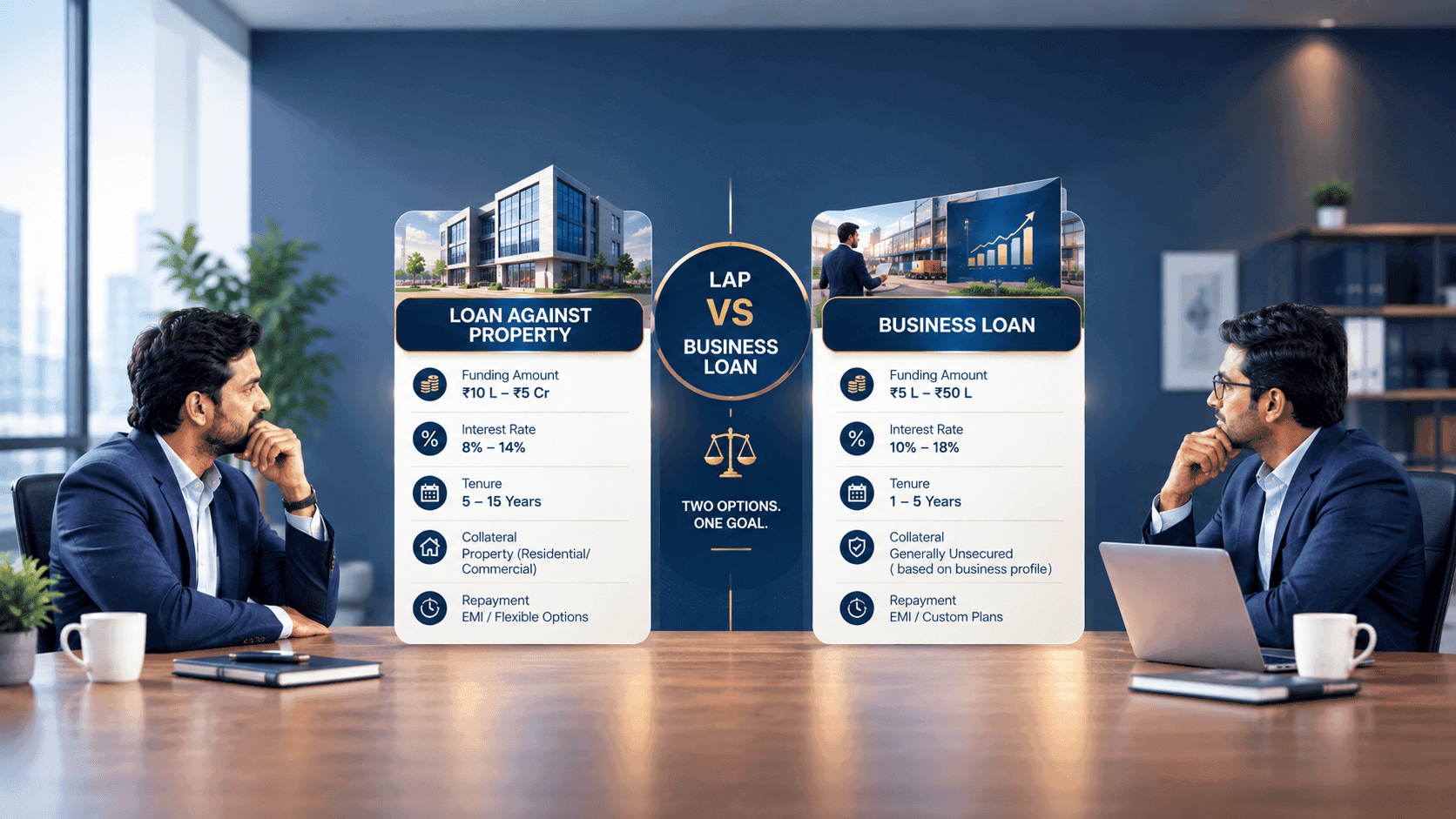
When a business needs additional funding, choosing the right loan can be as important as getting the loan itself.
Two common options for Indian business owners are a Loan Against Property (LAP) and a Business Loan. Both can provide substantial funding, but they work differently.
A Loan Against Property is secured against an eligible residential, commercial or other acceptable property. A Business Loan can be secured or unsecured depending on the product, lender and borrower profile.
The right choice depends on how much money the business needs, how quickly it needs the funds, whether property is available as security, how long the funding is required, the purpose of the money and how comfortably the business can repay it.
Quick answer
A Business Loan is generally more suitable for businesses that need faster, unsecured or relatively flexible funding without pledging property, subject to eligibility and lender terms.
A Loan Against Property can be more suitable when a business needs a larger amount, has an eligible property to offer as security and wants a longer repayment period, although the property is exposed to the consequences of default.
There is no universally better option. The better loan is the one that matches the business's funding requirement, cash flow and risk capacity.
What Is a Loan Against Property?
A Loan Against Property is a secured loan where an eligible property is pledged to the lender as collateral.
Depending on the lender and product, the property may be owned by:
The business
Proprietor
Partners
Directors
Certain relatives, subject to lender policy
For example, SBI's asset-backed MSME lending product accepts certain immovable properties belonging to the unit, proprietor, partners, directors or near relatives, subject to its conditions. Its listed LTV for that product is 60% of the realizable value of the immovable property.
The borrower continues to own the property while the loan is outstanding, but the lender has security over it.
If the borrower fails to meet the loan obligations and the account remains unresolved, the lender can enforce its security in accordance with applicable law and the loan agreement.
How LAP works
The basic structure is:
Property → Valuation → Eligible Loan Amount → Loan Sanction → Repayment
The lender typically evaluates:
Property ownership
Property type
Market/realizable value
Legal title
Location
Existing encumbrances
Borrower's income
Business cash flow
Credit history
Repayment capacity
The amount you can borrow is therefore not necessarily equal to the property's market value.
What Is a Business Loan?
A Business Loan is financing provided for business-related purposes such as:
Business expansion
Working capital
Equipment
Inventory
Marketing
Technology
Business setup
Operational expenses
Expansion into new locations
Business loans can be structured as secured or unsecured.
An unsecured business loan does not require a specific property to be pledged as collateral, although the lender still evaluates the borrower's creditworthiness and repayment capacity.
For MSMEs, RBI's current MSME lending framework provides specific collateral-related provisions. For example, banks are mandated not to accept collateral security for loans up to ₹10 lakh to MSE units, with provisions allowing banks, based on track record and financial position, to dispense with collateral for loans up to ₹25 lakh with appropriate approval.
This should not be confused with saying that every business loan is automatically collateral-free. Product eligibility, lender policy, borrower category and loan amount all matter.
Loan Against Property vs Business Loan: At a Glance
Factor | Loan Against Property | Business Loan |
|---|---|---|
Security | Property generally required | May be unsecured or secured |
Funding amount | Can support larger requirements depending on property and repayment capacity | Depends on lender and borrower profile |
Interest cost | Often competitive because it is secured | Can be higher for unsecured facilities |
Tenure | Can be relatively long | Usually depends on product |
Processing | Property and legal checks can add time | Can be faster for eligible borrowers |
Property risk | Property pledged as security | No property risk if genuinely unsecured |
Documentation | Financial + property documents | Primarily financial, banking and KYC documents |
Best suited for | Large, long-term funding | Flexible business funding |
Valuation required | Generally yes | Not for unsecured loans |
Main advantage | Larger secured funding | Convenience and no property pledge |
Main drawback | Property is at risk in default | Higher cost may apply for unsecured borrowing |
Actual interest rates, tenure, loan-to-value ratios, fees and eligibility vary by lender and product.
How Much Funding Do You Need?
The first question should not be:
"Which loan has the lowest interest rate?"
Instead ask:
"How much funding does my business actually need, and for how long?"
This distinction can prevent over-borrowing.
Example
Suppose an MSME needs:
₹15 lakh for 18 months
for additional inventory and working capital.
Pledging a property for a relatively small short-term requirement may create unnecessary complexity and asset risk.
Now consider another business that needs:
₹1.5 crore for five years
to expand manufacturing capacity, purchase equipment and establish a new facility.
If the business has a suitable property and sufficient repayment capacity, a secured facility such as LAP may be worth evaluating.
The amount and duration of funding can therefore change the answer.
When Is a Business Loan Better?
A Business Loan may make more sense in several situations.
1. You Do Not Want to Pledge Property
This is the most obvious advantage of an unsecured Business Loan.
If your business has strong financials but you do not want to mortgage your home, office or other property, an unsecured facility can preserve that asset.
This is particularly relevant when the funding requirement is moderate and the business can comfortably service the loan from operating cash flow.
2. You Need Funds Quickly
Property-backed financing usually involves additional processes such as:
Property valuation
Legal verification
Title checks
Documentation
Security creation
An unsecured Business Loan may involve fewer asset-related checks.
For a business facing an urgent opportunity—such as purchasing inventory for a confirmed order—speed can have significant economic value.
However, actual processing time depends on the lender, documentation and borrower profile.
3. Your Funding Requirement Is Moderate
If you need ₹10–30 lakh and have sufficient turnover, banking history and repayment capacity, an unsecured business-finance product may be more practical than pledging a property.
The exact amount available depends on the lender.
4. You Want to Protect Personal Assets
A property may represent decades of personal wealth.
Using it as collateral changes the risk profile of the borrowing.
If the business encounters prolonged financial stress, the pledged property can be exposed to enforcement proceedings.
Therefore, business owners should consider not only:
"Can I get this loan?"
but also:
"What happens if my business has a bad year?"
When Is a Loan Against Property Better?
LAP becomes more attractive when the business requires substantial funding and has a suitable property available.
1. You Need a Larger Loan
Property can provide a substantial security base.
The amount available depends on:
Property value
LTV permitted by lender
Borrower's income
Business cash flow
Existing liabilities
Credit profile
Property type
Location
Legal status
For example, SBI's asset-backed MSME facility currently lists an LTV of 60% of the realizable value of the immovable property for that specific product.
This illustrates why:
Property value ≠ loan amount
If a property is worth ₹1 crore, a lender does not necessarily provide ₹1 crore.
2. You Need Longer-Term Funding
A longer tenure can reduce the monthly repayment burden, although extending the tenure can increase the total interest paid.
This can be useful for funding that produces returns over several years, such as:
Business expansion
New manufacturing capacity
Commercial premises
Large equipment
Long-term infrastructure
Expansion into new markets
The loan tenure should match the economic life of what the funding is being used for.
3. You Have a Valuable Property but Limited Unsecured Borrowing Capacity
A business may have strong assets but insufficient eligibility for a large unsecured loan.
In such cases, property-backed financing can unlock additional borrowing capacity.
However, the lender still evaluates repayment capacity. Property alone does not make an unaffordable loan safe.
Interest Rate: Which One Is Cheaper?
This is one of the most common comparisons, but there is no single rate that applies to every borrower.
Generally, secured borrowing can be priced more competitively because the lender has collateral.
Unsecured Business Loans can carry higher pricing because the lender has less direct security.
But comparing only the advertised interest rate is not enough.
Look at the total borrowing cost:
Total Cost = Interest + Processing Fee + Documentation/Legal Charges + Valuation Charges + Other Applicable Fees
Also check:
Prepayment terms
Foreclosure charges
Penal charges
Insurance requirements
Renewal fees
Documentation expenses
A loan with a slightly higher interest rate could still be economically preferable if it avoids substantial collateral-related costs or provides the funds significantly faster.
Loan Tenure: Why It Matters
Suppose a business borrows:
₹50 lakh
A longer tenure can reduce the monthly EMI.
But the borrower may pay more interest over the full life of the loan.
Consider the conceptual difference:
Shorter tenure
Higher EMI → Lower total interest
Longer tenure
Lower EMI → Higher total interest
The right choice depends on business cash flow.
A company with volatile monthly cash flows may need more repayment flexibility than a business with stable recurring revenue.
Collateral Risk: The Biggest Difference
This is arguably the most important distinction.
With an unsecured Business Loan:
No property is pledged as collateral, assuming the product is genuinely unsecured.
With LAP:
Property is pledged to the lender.
This means the business owner should evaluate the worst-case scenario.
Ask:
How essential is this property to my family?
Is it the business premises?
Could losing it disrupt operations?
How volatile are my business revenues?
Do I have adequate cash reserves?
Is the loan being used for an asset that generates enough cash to service the debt?
A lower interest rate does not automatically compensate for taking an inappropriate level of collateral risk.
Loan Against Property vs Business Loan for Different Business Needs
Business Requirement | Generally Worth Considering |
|---|---|
Short-term working capital | Business Loan / CC / OD |
Emergency business funding | Business Loan |
Inventory purchase | Working-capital facility / Business Loan |
Small expansion | Business Loan |
Large expansion | LAP or secured business finance |
Machinery purchase | Equipment finance / Business Loan |
Purchase or construction of premises | Property/project finance |
Long-term business investment | LAP / secured term finance |
No property available | Business Loan |
Property available and large funding required | LAP |
This is a decision framework, not a universal approval rule.
Can You Use a Loan Against Property for Business Purposes?
Yes, lenders offer property-backed financing that can be used for business purposes, subject to product terms and end-use restrictions.
For example, Federal Bank's property-loan eligibility information includes sole proprietorships and family partnerships among eligible borrower categories for certain property loans, with business use permitted under specified conditions.
However, borrowers should always confirm:
Permitted end use
Eligible property type
Borrower structure
Loan-to-value ratio
Repayment terms
Documentation requirements
Do not assume that every LAP product permits every type of business expenditure.
Can a Business Loan Be Collateral-Free?
Yes, some Business Loans can be unsecured.
But "business loan" does not automatically mean "collateral-free."
A lender may offer:
Unsecured business loans
Secured business loans
Cash credit
Overdraft
Equipment finance
Invoice financing
Property-backed business finance
For eligible MSE borrowers, RBI's framework provides collateral-free provisions at specified thresholds, while the Ministry of MSME's 2025 "Know Your Lender" handbook reiterates the ₹10 lakh mandatory collateral-free provision and the possibility of higher collateral-free limits up to ₹25 lakh based on track record and financial position with appropriate approval.
What Documents Are Usually Required?
Business Loan
Common requirements may include:
PAN
KYC documents
GST registration
GST returns
ITR
Bank statements
Financial statements
Business proof
Udyam Registration
Existing loan details
Depending on the lender, additional documents may be required.
Loan Against Property
LAP can require all of the above plus property-related documentation such as:
Sale deed
Title documents
Property tax records
Approved building plans, where applicable
Encumbrance-related documents
Property valuation
Legal verification
Existing mortgage information
Exact requirements vary by lender and property type.
How Banks Decide Which Loan You Qualify For
Regardless of the product, lenders typically want to understand one fundamental question:
Can the borrower repay the proposed loan comfortably?
They can assess:
Business performance
Revenue
Profitability
Growth
Operating cash flow
Banking behaviour
Account conduct
Transaction volume
EMI payments
Existing borrowing
Credit profile
Credit history
Existing obligations
Repayment behaviour
Business stability
Vintage
Industry
Customer concentration
Business model
For LAP
Additionally:
Property ownership
Property value
Property location
Legal title
Existing encumbrances
LTV
A property can strengthen security, but it does not eliminate the need for repayment capacity.
A Practical Example
Consider an MSME with:
Annual turnover: ₹4 crore
Annual profit: ₹35 lakh
Funding requirement: ₹60 lakh
The business owns a commercial property worth approximately ₹1 crore.
The owner is considering:
Option A — Unsecured Business Loan
or
Option B — Loan Against Property
Business Loan may be preferable if:
The business can qualify for ₹60 lakh
Cash flow comfortably supports the EMI
The owner wants to avoid pledging property
Funds are needed quickly
The business can tolerate potentially higher borrowing costs
LAP may be preferable if:
The unsecured loan eligibility is insufficient
The business wants a longer repayment period
The property is suitable collateral
The owner is comfortable with the security risk
The business needs a larger secured facility
The cheapest option is not automatically the best option.
The correct decision should consider total cost + repayment burden + collateral risk + business purpose + funding duration.
What If You Need Working Capital?
This is where businesses sometimes choose the wrong product.
Suppose you need money because:
Customers pay after 60 days
Inventory needs to be purchased upfront
Suppliers require faster payment
A long-term LAP may not necessarily be the most efficient solution.
A Cash Credit, Overdraft, Working Capital Loan or another revolving working-capital facility may be better suited because the funding requirement follows the business's operating cycle.
On the other hand, if the business needs ₹1 crore for a long-term expansion project, a term facility may be more appropriate.
Match the loan to the cash-flow pattern
Short-term requirement → Shorter/revolving funding
Long-term investment → Term funding
This simple principle can prevent a significant funding mismatch.
Major Mistakes to Avoid
1. Choosing Based Only on Interest Rate
A lower rate can be attractive, but collateral risk and total borrowing cost matter too.
2. Pledging Property for a Small Requirement
Do not automatically mortgage a valuable asset when a smaller unsecured facility can adequately solve the problem.
3. Taking an Unsecured Loan for a Long-Term Project
A high-cost short-tenure loan can create unnecessary EMI pressure when the underlying investment takes years to generate returns.
4. Borrowing More Than the Business Needs
A larger sanctioned limit does not mean the business should use it.
Borrow according to actual funding requirements.
5. Ignoring Cash Flow
Loan eligibility and repayment capacity are not the same thing.
A business should calculate its expected monthly debt obligation before accepting the facility.
6. Using Working-Capital Debt for Permanent Assets
Funding long-term assets entirely through short-term borrowing can create a mismatch between the asset's economic life and the repayment structure.
Decision Framework: Which Loan Should You Choose?
Use these questions before applying.
Question 1: How much do you need?
Under ₹25 lakh: Explore suitable Business Loan/working-capital options first.
₹25 lakh–₹1 crore: Compare unsecured and secured options based on eligibility and cost.
Above ₹1 crore: Evaluate secured funding, LAP and other structured business-finance options carefully.
These are broad decision ranges, not lender eligibility rules.
Question 2: How long will you need the money?
Under 2 years: Flexible business/working-capital facilities may make more sense.
3–5+ years: Consider structured term financing and LAP where appropriate.
Question 3: Do you have suitable property?
If no:
LAP may not be available.
If yes:
Compare the secured option against alternatives.
Question 4: How strong is your cash flow?
Strong, predictable cash flow gives you more flexibility.
Unpredictable cash flow calls for caution because the EMI remains payable even when sales temporarily decline.
Question 5: Are you comfortable risking the property?
If the answer is no, do not choose LAP simply because its pricing may appear attractive.
Loan Against Property vs Business Loan: Final Comparison
Parameter | Loan Against Property | Business Loan |
|---|---|---|
Collateral | Property | May be unsecured |
Suitable for large funding | Often yes | Depends on lender |
Processing complexity | Higher due to property checks | Usually simpler for unsecured products |
Interest | Often competitive for secured products | Can be higher for unsecured products |
Property risk | Yes | No for genuinely unsecured loans |
Long-term funding | Suitable in many cases | Depends on product |
Working capital | Possible, but product fit matters | Often more convenient |
Speed | Can be slower | Often faster |
Documentation | Business + property | Primarily business/financial |
Best for | Large, longer-term secured funding | Flexible business funding without property |
Conclusion
There is no universal winner between a Loan Against Property and a Business Loan.
A Business Loan may be the better choice when you need relatively flexible funding, want to avoid pledging property and have sufficient business cash flow to support the repayment.
A Loan Against Property may be worth considering when you need a larger amount, have suitable property available and want secured, potentially longer-term funding.
The decision should ultimately come down to five questions:
How much do I need?
How long do I need it?
What will the money generate?
Can my business comfortably repay it?
What asset am I willing to put at risk?
The best business funding is not necessarily the loan with the lowest interest rate. It is the facility whose cost, tenure, repayment structure and risk profile match the business's actual financial needs.