

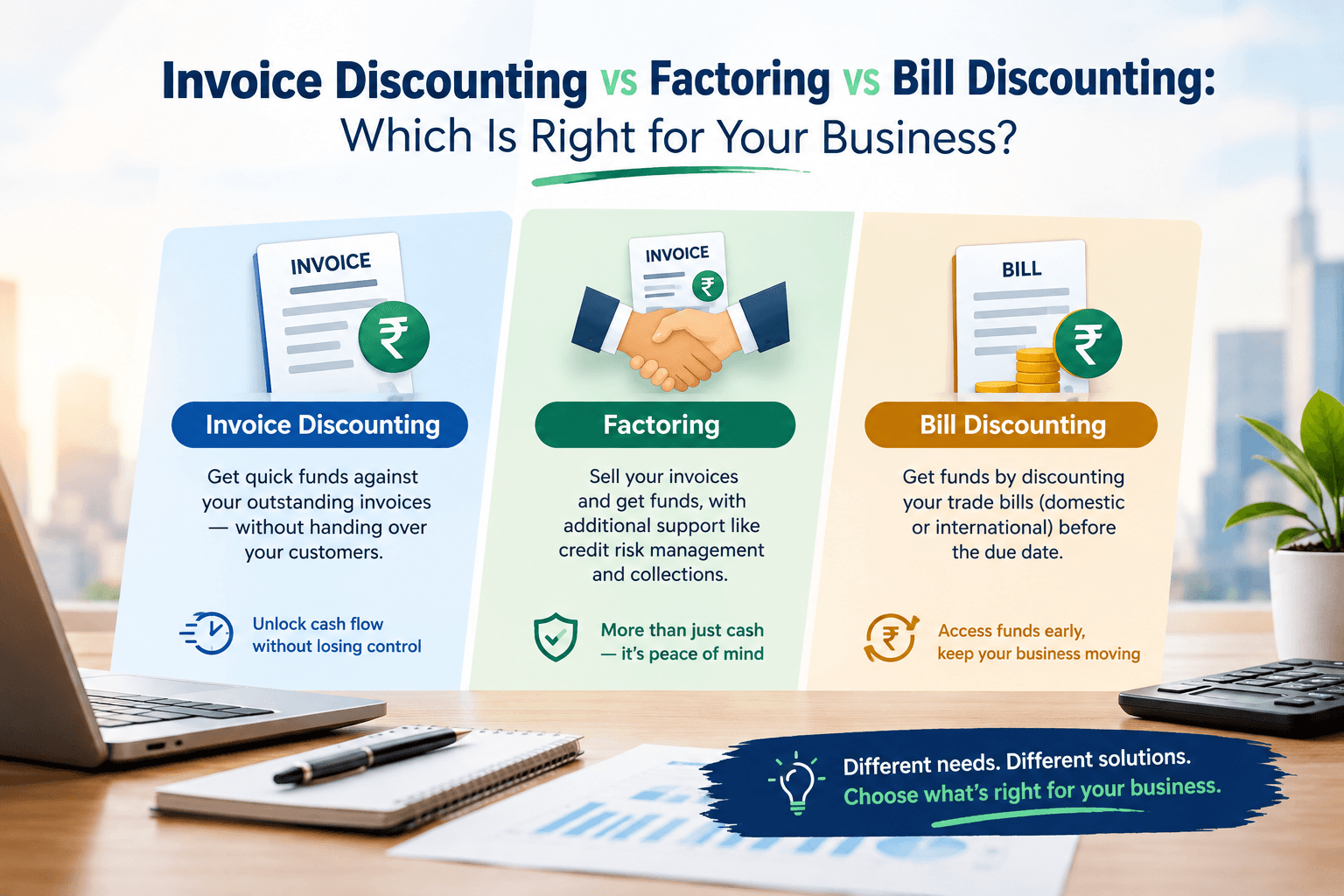
Quick answer: All three let you get cash against unpaid customer invoices instead of waiting 30 to 90 days. Invoice discounting is a loan against your invoices while you keep collecting from customers. Factoring means a financier buys your receivables and often handles collection. Bill discounting is a bank facility where bills drawn on your buyer are discounted for immediate funds.
Your orders are growing. Customers are paying, just not on time.
That is the gap that stresses many Indian businesses. You buy raw material and pay wages today, but the customer pays in 60 or 90 days. The business looks profitable on paper, yet cash is always tight.
Invoice-based finance exists to close that gap. Instead of waiting for the customer, you use the unpaid invoice itself to raise funds.
The three most common routes are invoice discounting, factoring and bill discounting. They sound similar, but they work differently, cost differently and suit different businesses. If you are comparing them with other working-capital products, read our guide on Working Capital Loan vs Cash Credit vs Overdraft as well.
Why Delayed Payments Create a Cash-Flow Problem
Consider a simple example.
A supplier sends goods worth ₹10 lakh to a large buyer on 60-day credit. During those 60 days, the supplier still has to pay for:
Raw material for the next order
Employee salaries
Rent, power and transport
GST on the sale, which may fall due before payment arrives
The sale is real, but the cash is stuck. Invoice finance releases part of that cash early.
What Is Invoice Discounting?
Invoice discounting is a facility where a lender advances money against your unpaid invoices. You continue to manage your customer relationship and collect payment yourself.
How it works:
You raise an invoice to your customer.
You submit the invoice to the lender.
The lender advances a portion of the invoice value, often a major share but not 100%.
The customer pays on the due date.
You repay the lender, who deducts its charges, and the remaining amount is settled.
Key features:
You usually stay in control of collection
The arrangement can be confidential in some structures, so the customer may not know
The lender mainly looks at the strength of the invoice and the buyer’s credit quality
It suits businesses with regular invoices from reliable buyers
What Is Factoring?
In factoring, a financier, called the factor, purchases your receivables. It advances funds against them and often takes over collection and sales-ledger management.
Two common types:
With recourse: if the buyer does not pay, you must take the loss back from the factor.
Without recourse: the factor bears the buyer’s non-payment risk, subject to the agreement. This usually costs more.
Key features:
The customer usually knows, because payment is directed to the factor
You can save the effort of chasing payments
It suits businesses that lack a strong collections team
In India, factoring is regulated, and NBFC factors operate under RBI rules
What Is Bill Discounting?
Bill discounting is a traditional bank facility. You raise a bill, such as a bill of exchange drawn on your buyer. The bank pays you the bill value, minus a discount charge, before the due date. When the bill matures, the buyer pays the bank.
Key features:
Commonly offered as part of a bank working-capital limit
It is linked to genuine trade transactions
The bank assesses both your credit and the buyer’s
It suits businesses already banking with the lender
Invoice Discounting vs Factoring vs Bill Discounting
Who collects payment
Invoice discounting: you
Factoring: usually the factor
Bill discounting: the bank collects on maturity
Customer awareness
Invoice discounting: can be confidential
Factoring: the customer is usually informed
Bill discounting: the buyer accepts or is aware of the bill
Credit risk
Invoice discounting: stays with you
Factoring: stays with you (with recourse) or moves to the factor (without recourse)
Bill discounting: depends on the bank’s terms and the bill’s acceptance
Best for
Invoice discounting: businesses with strong buyers and their own collection process
Factoring: businesses that want collections handled and credit-risk cover
Bill discounting: businesses with established bank relationships and trade bills
Typical cost
Invoice discounting: discount charge plus processing fees
Factoring: discount charge plus factoring or service fees
Bill discounting: discount charge, often within a bank facility
What Does Invoice Finance Actually Cost? An Illustrative Example
The numbers below are only an example, not a quote. Real pricing depends on the lender, your profile and the buyer.
Invoice value: ₹10,00,000
Advance: 80% = ₹8,00,000
Period: 60 days
Assumed annual discount rate: 12%
Assumed processing fee: ₹5,000
Discount charge: ₹8,00,000 × 12% × 60 ÷ 365 ≈ ₹15,800
Total cost: about ₹20,800
So you pay roughly ₹20,800 to get ₹8 lakh two months early. Whether that is worth it depends on what the cash lets you do. If the funds let you take on a profitable repeat order, the cost may be small compared with the gain.
Always ask about the full cost:
Discount or interest rate
Processing fee
Service or factoring fee
Late-payment charges if the buyer pays after the due date
Any minimum charges or renewal fees
Struggling with delayed customer payments? Talk to an Express Dhan advisor and find the right receivables funding for your business. → Talk to an Advisor
What About TReDS?
TReDS stands for Trade Receivables Discounting System. These are RBI-regulated electronic platforms where MSME sellers upload invoices, large buyers accept them and multiple financiers bid to fund them.
Why it matters for MSMEs:
Funding is based on the buyer’s credit standing, which can help smaller suppliers
Competition among financiers can improve pricing
The process is digital and trackable
It works best when your buyers are large companies registered on a TReDS platform.
Why Delayed Payments Are Getting More Important to Manage
Indian rules put pressure on delayed payments to micro and small suppliers. Payments to such suppliers are expected within a short statutory window, and tax rules can disallow the buyer’s expense deduction if payment runs beyond it. This pushes some buyers to pay faster, but many suppliers still face long credit cycles. Check the current rule with your CA, as these provisions can change.
Which One Should You Choose?
Choose invoice discounting if:
You have regular invoices from creditworthy buyers
You want to manage your own customer relationships
You can chase payments yourself
Choose factoring if:
You want to outsource collections
You want protection against buyer non-payment (non-recourse)
Your team is small and chasing payments takes too much time
Choose bill discounting if:
You already bank with the lender
Your trade is documented through bills
You want it as part of a bank limit
Consider TReDS if:
Your buyers are large corporates or government bodies on the platform
You are an MSME looking for competitive pricing
Invoice Finance vs Other Working-Capital Options
Invoice finance is not the only answer. If your cash flow is steady but the amount needed is larger, or the need is ongoing, a cash credit limit or overdraft may suit you better. Read Cash Credit Limit for MSMEs: How Banks Calculate CC Limits. If you want a lump sum for growth, a term loan may be more suitable.
The right choice depends on:
How often you invoice
How long customers take to pay
How reliable your buyers are
How much cash you need and for how long
Whether you can afford the total cost
Common Mistakes to Avoid
Funding every invoice automatically. Check whether the cost is worth it for each deal, especially on low-margin sales.
Ignoring recourse terms. If the facility is with recourse, you still carry the risk if the buyer defaults.
Not reading the fee structure. Small fees add up.
Depending on one big buyer. If most invoices come from one customer, the lender may limit your facility.
Weak invoice records. Disputed or poorly documented invoices are hard to fund. Keep purchase orders, delivery proof and GST invoices ready.
Documents Usually Needed
KYC and business registration documents
GST returns and bank statements
Financial statements
Sample invoices, purchase orders and delivery proof
Buyer details and past payment history
See our checklist Business Loan Documents Required in India for the full list.
Final Verdict
Invoice discounting, factoring and bill discounting all solve the same problem: cash trapped in unpaid invoices. The difference lies in who collects, who bears the risk and how much it costs.
For most MSMEs with reliable buyers, the best approach is to work out the real cost, confirm the recourse terms and match the product to how your business actually gets paid. Used selectively, invoice finance can turn waiting time into working capital without taking a large long-term loan.
Want to compare receivables funding options for your business? Talk to Express Dhan. → Check My Options
Also read: Working Capital Loan vs Cash Credit vs Overdraft · Cash Credit Limit for MSMEs · How Banks Calculate Business Loan Eligibility