

When a business loan reaches the sanction stage, insurance often enters the conversation. Some of it is a genuine condition of the loan. Some of it is a product the bank or its partner wants to sell.
For Indian business owners, the difference matters. A required policy protects the asset behind the loan. An unrelated policy can add cost, add interest and add nothing to your credit file.
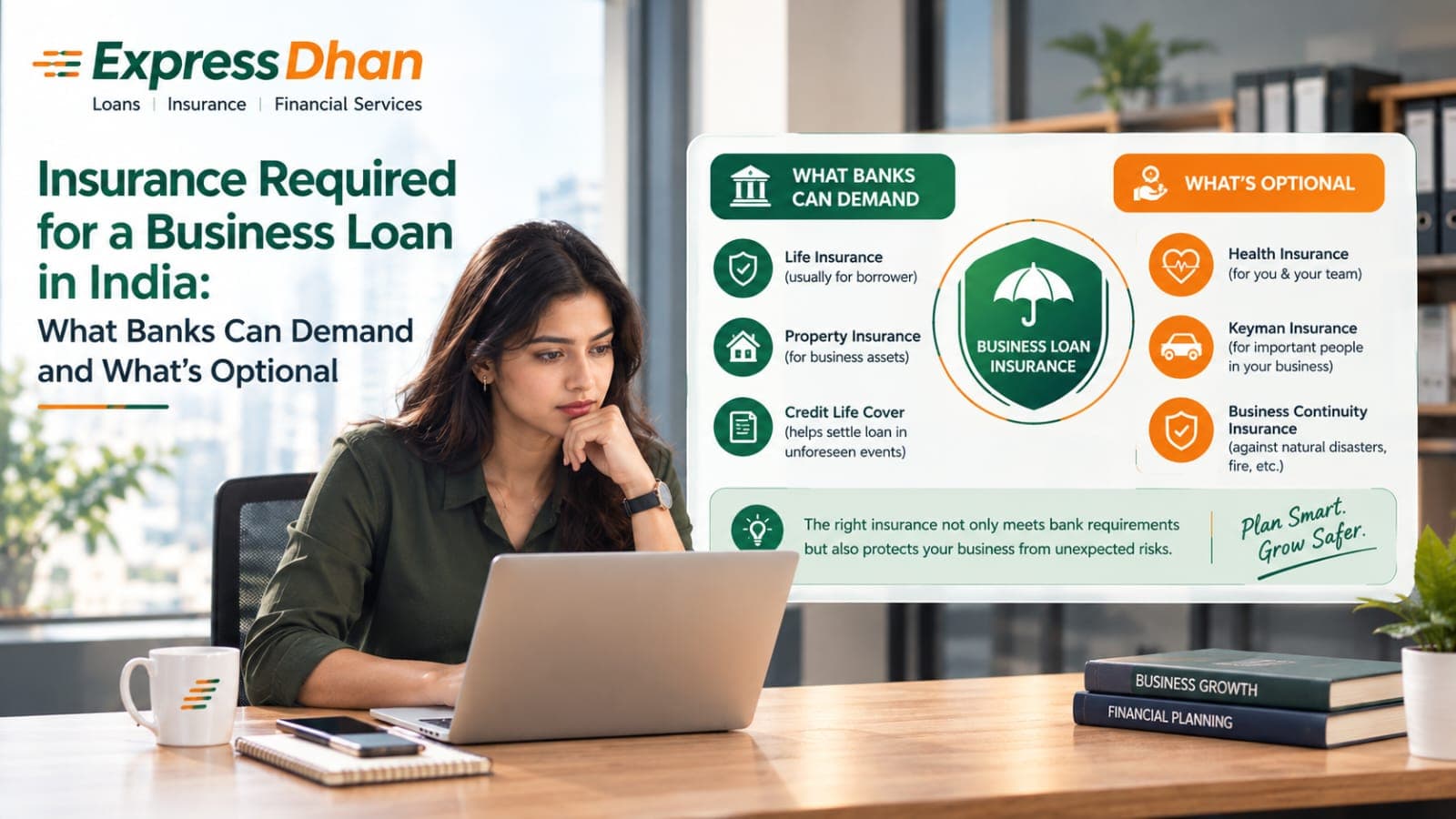
Insurance around a business loan falls into three groups: security-linked cover the lender can require, optional cover that may still be worth buying, and cross-selling that you can decline.
The right approach depends on which asset secures the loan, what the sanction letter says, who pays the premium and who chooses the insurer.
Quick answer
A bank can generally require insurance only on the assets it holds as security: hypothecated stock, financed machinery, mortgaged property and financed vehicles, subject to lender policy and the sanction terms.
Life, health and savings-linked policies are not a condition of a business loan. From 1 January 2027, RBI's rules also bar banks from making a loan conditional on buying another product. Where insurance is genuinely needed as a risk mitigant, you must be free to choose the provider.
There is no single policy every borrower must buy. The test is simple: does the policy protect the security behind the loan, and is it written in the sanction letter?
What Is Security-Linked Insurance?
Security-linked insurance covers an asset or receivable on which the lender holds a charge, such as a hypothecation, mortgage or lien.
The borrower keeps ownership and use of the asset while the loan is outstanding. The lender's interest is recorded on the policy through a bank clause (also called a hypothecation clause), so claim proceeds are paid to the bank up to the extent of its dues.
How it works
The basic structure is:
Asset → Charge in favour of lender → Insurance → Bank clause → Claim → Loan dues settled first
The lender typically checks:
Nature of the security
Value of the asset
Sum insured against that value
Perils covered
Whether the bank clause is endorsed
Insurer and policy validity
Renewal dates
The insurance the lender requires is therefore linked to the security, not to the loan amount alone.
What Is Optional Insurance?
Optional insurance is cover a lender may recommend, or that suits your business, but that is not a condition of the loan. Examples include:
Credit life or loan protection cover
Keyman insurance
Business interruption cover
Group health and personal accident cover for employees
Some of these can be valuable. But they should be judged on merit, not bought under sanction-stage pressure.
What Is Cross-Selling?
Cross-selling is a policy that has no link to the security behind the loan but is presented as necessary to get it sanctioned. Examples include:
Endowment, money-back or ULIP plans described as "investment-linked" or "for tax planning"
Health insurance for the promoter's family, framed as "strengthening the file"
Motor insurance on a personal vehicle unconnected to the loan
A life policy on someone who is neither borrower nor guarantor
Any policy whose premium seems calibrated to the loan amount rather than to a real risk
The Three Types of Insurance at a Glance
Factor | Security-Linked (Required) | Optional | Cross-Selling |
|---|---|---|---|
What it protects | Asset the bank holds a charge over | Your business, family or repayment capacity | Usually nothing linked to the loan |
Written in sanction letter | Generally yes | Not required | No |
Can the bank insist on it | Yes, as a documented condition | No | No |
Can you choose the insurer | Yes, under RBI's rules effective 1 January 2027 | Yes | Yes |
Typical examples | Stock fire and burglary, machinery fire, property fire, vehicle comprehensive | Term or credit life, keyman, business interruption | ULIPs, family health, personal motor |
Best approach | Buy, and buy adequately | Evaluate on merit | Decline |
Actual requirements vary by lender, facility and product.
What Do RBI's New Rules Say About Bundling Insurance With Loans?
On 15 June 2026, the Reserve Bank of India issued the Responsible Business Conduct (Second Amendment) Directions for commercial banks. They take effect on 1 January 2027. Three provisions matter to borrowers:
Compulsory bundling is prohibited. A bank cannot make one product conditional on your buying another, whether its own or a third party's.
You choose the provider where insurance is a risk mitigant. If a policy is needed to protect the lender's risk, the bank can require the cover, but you must be free to buy it from any provider.
Funding a product from your loan needs explicit consent. A bank cannot fund the purchase of a product out of a loan facility sanctioned to you without your explicit consent.
Source: RBI notification RBI/2026-27/115
These directions take effect on 1 January 2027, so confirm how your lender is applying them at the time of sanction.
Which Insurance Is Generally Expected for Each Type of Facility?
Facility | Insurance Generally Expected | Why |
|---|---|---|
Cash credit / overdraft | Fire and allied perils on hypothecated stock, usually with burglary cover, with a bank clause | Drawing power is calculated on that stock |
Term loan / machinery loan | Fire policy on machinery, often with machinery breakdown; erection all-risk for new or imported equipment | Protects the financed asset |
Loan against property / project loan | Fire and allied perils on the structure with the bank endorsed; contractor's all-risk during construction | Protects the mortgaged property |
Vehicle / commercial vehicle loan | Comprehensive own-damage cover with the financier endorsed | Protects the financed vehicle |
Packing credit / post-shipment finance | ECGC cover on buyer or country risk | Protects the receivable behind the advance |
Third-party motor cover is separately mandatory under the Motor Vehicles Act, whether or not the vehicle is financed.
This is a decision framework, not a universal rule. Your sanction letter is the final word on what applies to your loan.
When Is Insurance Genuinely Required?
Insurance makes sense as a lender's condition whenever the loan is backed by an asset that can be damaged or lost.
1. You Have Hypothecated Stock
If your cash credit or overdraft limit is backed by stock and book debts, the bank will expect a fire and allied perils policy, usually with burglary cover. Your drawing power depends on that stock. If it burns down uninsured, the security behind your limit disappears.
2. You Have Financed Machinery
Machinery bought with a term loan is usually required to be insured under a fire policy, often with machinery breakdown cover as well.
3. You Have Mortgaged Property
Where immovable property is mortgaged, the structure (not the land) is insured against fire and allied perils, with the bank endorsed on the policy.
4. You Have a Financed Vehicle
Comprehensive own-damage cover with the financier endorsed is standard.
5. You Are an Exporter
Pre-shipment and post-shipment lenders often ask for ECGC cover, because it protects the receivable that supports the advance.
An uninsured asset is a risk to your own balance sheet too. Treat these policies as protection, not as an imposition.
When Is Optional Insurance Worth Buying?
1. Repayment Depends on One Person
In a proprietorship or closely held company, the loan may depend on a single promoter's income. Credit life or term cover can make sense here. The problem is usually the packaging, not the idea.
Bank-distributed credit life is often sold as a single premium funded into the loan. A plain term policy for the same sum assured, bought directly and paid annually, usually costs less and stays with your family after the loan closes.
2. The Business Depends on a Key Person
Keyman insurance covers a director or key employee whose absence would damage the business, with the company as beneficiary. Lenders view it favourably in promoter-dependent businesses.
3. You Operate From a Single Location
Business interruption cover pays for loss of gross profit after an insured event. It is sensible for single-location manufacturers and rarely mandated.
4. You Have Employees
Group health and group personal accident cover can be useful, and sometimes required in manufacturing and construction, but it is unrelated to your loan sanction.
When Is It Cross-Selling?
Learn to recognise the language. Phrases such as:
"The processing team expects it"
"It helps the file move"
"It's a relationship requirement"
"Everyone at your ticket size does this"
describe a sales target, not a credit condition.
A real credit condition appears in writing in the sanction letter. If it isn't there, it isn't a condition.
Premium Funded Into the Loan: What It Really Costs
"We'll add it to the loan amount" sounds like a convenience. The real cost is different.
Effective Cost = Premium + Interest on the Premium over the full tenure
Example
Take a ₹50 lakh business loan at 11% for seven years.
Without funded premium | With ₹1.25 lakh premium funded | |
|---|---|---|
Loan amount | ₹50 lakh | ₹51.25 lakh |
EMI | ~₹85,600 | ~₹87,750 |
Total repayment | ~₹71.9 lakh | ~₹73.7 lakh |
You pay about ₹1.80 lakh for a ₹1.25 lakh policy. The extra ₹55,000 is interest on money borrowed to pay the premium.
Consider the conceptual difference:
Premium funded into the loan
No cash outgo today → Higher total cost → Partly refundable on prepayment, if at all
Annual premium bought separately
Outgo each year → Lower total cost → Stays with you after the loan closes
If you prepay or refinance in year three, the unused portion of a funded premium is typically only partly recoverable. RBI's directions also require your explicit consent before a bank funds a product from your loan.
Getting the Required Cover Right
Being required to insure is not the same as being insured properly. Three details cost borrowers money.
1. Under-Insurance and the Average Clause
If you insure ₹60 lakh of stock when you hold ₹1 crore, you are not 60% covered on every claim. Under the average clause, a ₹20 lakh loss is settled at roughly ₹12 lakh. Review the sum insured against peak stock levels, not average ones.
2. Market Value vs Reinstatement Value
Machinery insured on market value settles at depreciated value. That will not replace a ten-year-old machine. Reinstatement value cover costs marginally more and is what most manufacturers need.
3. A Lapsed Renewal
Most sanction letters make continuous insurance of charged assets a continuing covenant. A renewal missed by three weeks is technically a default and can give the lender grounds to act on the facility. Diarise renewals and send the renewed copy to the branch every year.
The drawing power effect
Banks routinely exclude uninsured stock when calculating drawing power on a cash credit limit. If your stock statement shows ₹1 crore but only ₹60 lakh is insured, drawing power may be computed on ₹60 lakh less margin. Your limit hasn't changed on paper, but your usable money has shrunk.
A Practical Example
Consider a manufacturer with:
Hypothecated stock: ₹1 crore
Sanctioned cash credit limit: ₹75 lakh
Three days before disbursement, the relationship manager suggests three policies.
Policy A: Fire and burglary cover on stock, with bank clause
This protects the asset behind the limit. It is a genuine security-linked requirement, and the borrower can choose the insurer. Insure for peak stock value, not average.
Policy B: ₹1.25 lakh credit life plan, funded into the loan
This is optional. It may suit a promoter-dependent business, but the funded single-premium structure is the costliest way to buy it. Compare it with a term policy bought directly.
Policy C: Family health policy "to strengthen the file"
This is unrelated to the loan. It can be declined without affecting the sanction.
The right decision is not to refuse everything or accept everything. It is to sort each policy into the right group.
Major Mistakes to Avoid
1. Saying Yes at the Last Step
Disbursement is three days away and nobody wants to create friction. That is exactly when bargaining power is lowest. Read the sanction letter before you agree.
2. Letting the Premium Be Funded Without Checking the Cost
A funded premium can cost about 44% more than its face value over seven years, as the example above shows.
3. Assuming You Must Buy From the Bank's Insurer
Where insurance is a genuine risk mitigant, you are entitled to choose the provider under RBI's rules effective 1 January 2027.
4. Under-Insuring Stock
The average clause can turn an apparently adequate policy into a large shortfall at claim time.
5. Missing a Renewal
A lapse can be a covenant breach and can reduce drawing power.
6. Rejecting Useful Cover Out of Irritation
Some optional cover, such as term insurance for a promoter-dependent business, may genuinely be worth buying. Decide on merit, not on how it was sold.
Decision Framework: Should You Buy This Policy?
Use these questions before agreeing to any policy at sanction stage.
Question 1: Is it written in the sanction letter?
If yes, it is a documented condition. If no, it is a request, and you can decline.
Question 2: Does it protect an asset the bank holds a charge over?
If yes, the bank can reasonably require it. If no, it is optional or cross-selling.
Question 3: Who chooses the insurer?
Where the policy is a genuine risk mitigant, you should be free to choose. Ask for that in writing.
Question 4: Is the premium being funded from the loan?
If yes, confirm you have consented in writing and compare the total cost with paying the premium annually.
Question 5: Is the sum insured right?
Ask what the sum insured is, on what basis it was arrived at, and whether it reflects peak stock or reinstatement value.
Ask these politely and in writing. An email to the relationship manager is enough. Most unnecessary policies disappear at question one or two, without damage to the relationship.
What If You Were Already Pressured Into a Policy?
Complain in writing to the branch, with dates and the name of the person who linked the policy to your sanction.
Escalate to the bank's nodal or principal grievance officer.
If unresolved in 30 days, approach the RBI Ombudsman through the RBI complaint portal under the Reserve Bank – Integrated Ombudsman Scheme.
For product-specific issues such as mis-described benefits, use IRDAI's grievance channel or the Insurance Ombudsman.
Where mis-selling is established, RBI's directions provide for a refund and compensation. Keep the sanction letter, the email trail, and the policy document with its issue date relative to your disbursement date.
Required vs Optional vs Cross-Selling: Final Comparison
Parameter | Required (Security-Linked) | Optional | Cross-Selling |
|---|---|---|---|
Linked to loan security | Yes | Indirectly, if at all | No |
In sanction letter | Generally yes | No | No |
Choice of insurer | Yours | Yours | Yours |
Premium funded from loan | Only with explicit consent | Only with explicit consent | Avoid |
Cost impact if funded | Interest adds to premium | Interest adds to premium | Interest adds to a policy you didn't need |
Survives loan closure | Ends with the asset or loan | Term or keyman may continue | Depends on product |
Best approach | Buy adequately | Compare and decide | Decline |
Conclusion
Insurance against a business loan is not a scam. Insuring hypothecated stock, financed machinery and mortgaged property is normal, sensible lending practice, and a borrower who resists it is taking a risk with their own assets.
What is not normal is a savings-linked policy appearing three days before disbursement, funded out of the loan, on a life unrelated to the credit.
The decision should come down to five questions:
Is it in the sanction letter?
Which asset does it protect?
Do I choose the insurer?
Who is paying the premium, and at what total cost?
Is the sum insured right?
Requiring the cover is the bank's call. Choosing your insurer is yours.