

For most families, buying health insurance feels like a one-time decision. You compare a few premiums, pick a plan and file the policy away.
The problem shows up years later, at a hospital counter. The claim is reduced, a treatment is excluded, or the hospital isn't on the network list. By then it is too late to ask the questions that matter.
India's insurance regulator, IRDAI, has spent the last two years changing that. The rules on waiting periods, cashless treatment, claim disputes and taxes have all moved in the policyholder's favour. But the rules only help if you know they exist.
This guide explains what has changed, what it means for salaried employees, self-employed professionals and small business owners, and how to choose a health insurance plan with your eyes open.
What Changed in Health Insurance?
The biggest change is not one rule. It is a shift towards a simpler, more transparent and more claim-friendly system.
Earlier, most buyers asked three questions:
How much is the premium?
What is the sum insured?
Is my hospital on the list?
Those still matter, but a careful buyer should now also ask:
What is the waiting period for pre-existing diseases?
What is the moratorium period?
How fast will a cashless request be approved?
Can I port the policy without losing benefits?
What are the sub-limits and co-payment clauses?
Is the premium now GST-free?
Where do I complain if a claim is rejected?
Let's go through the changes that matter most.
1. GST on Individual Health Insurance Is Gone
From 22 September 2025, retail health and life insurance premiums became GST-exempt, following a decision by the 56th GST Council. Earlier, these premiums carried 18% GST.
For an individual or family policy, that is a direct saving on the premium you pay.
One detail is easy to miss. Group policies bought by employers still attract GST. If you run a business and buy group cover for your team, check how this applies to your premium before assuming the same saving.
Policyholder rule: Always compare the final premium payable, not only the base premium shown in an advertisement.
2. Waiting Period for Pre-Existing Diseases Is Shorter
A pre-existing disease is a condition you already have when you buy the policy, such as diabetes or high blood pressure. Insurers have traditionally made you wait before they cover it.
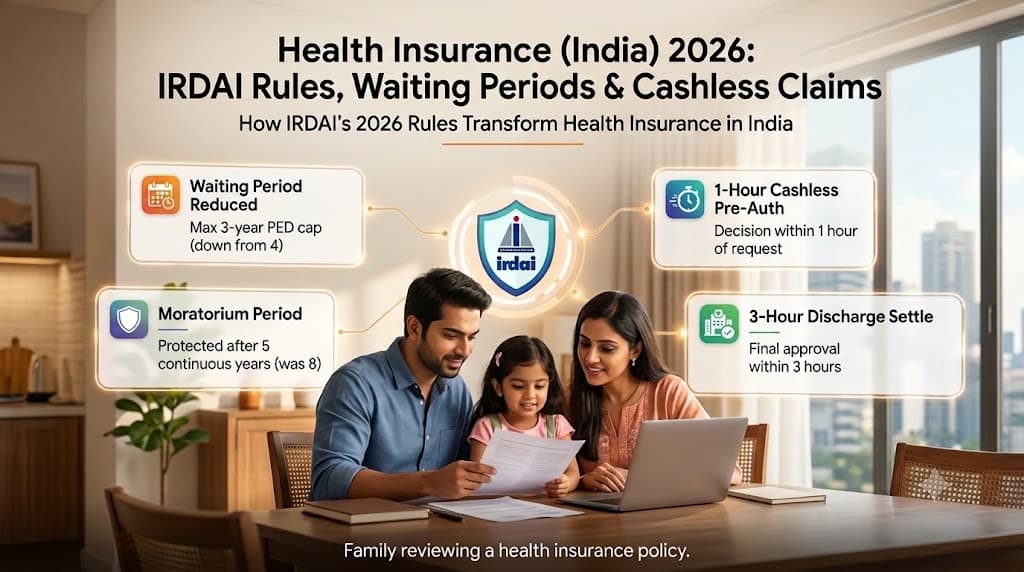
That wait has become shorter. The maximum waiting period for pre-existing diseases and specified diseases or procedures has come down from four years to three.
This is a ceiling. Some plans offer shorter waiting periods, and some charge more for them. Read the policy wording instead of assuming every plan gives the same terms.
3. The Moratorium Period Is Now Five Years
The moratorium period protects you from old disputes.
After a set number of continuous years with the same insurer, a claim generally cannot be rejected for non-disclosure or misrepresentation, except in cases of proven fraud. The moratorium period was reduced from 96 months to 60 months, effective April 2024.
In simple terms, if you have held continuous cover for five years, the insurer's ability to question your original disclosures is limited. That does not mean you can skip honesty at the start. It means your long-term loyalty is rewarded.
4. Cashless Claims Are Expected to Be Faster
Cashless treatment means the insurer pays the hospital directly. You do not arrange the money first.
Under IRDAI's 2024 Master Circular, insurers must approve cashless requests within 1 hour and process discharge within 3 hours.
There is also the General Insurance Council's "Cashless Everywhere" initiative, which aims to allow cashless treatment even at hospitals outside an insurer's network. Availability and conditions depend on the insurer and the hospital, so confirm this with your insurer before relying on it in an emergency.
Policyholder rule: Save your insurer's cashless helpline and your policy number in your phone today, not on the day of admission.
5. Age Is No Longer a Wall
For years, senior citizens struggled to buy health insurance. IRDAI has issued guidelines that an insurer cannot deny health insurance based on the policyholder's age.
That does not mean premiums are the same for everyone. Premiums still rise with age, and insurers can apply underwriting and waiting periods. But the door is no longer closed.
6. Treatments and Portability Have Improved
Two smaller changes make a real difference.
First, AYUSH treatments are covered under health insurance. Check the conditions in your plan, since coverage rules can differ.
Second, portability. You can switch to another IRDAI-licensed insurer without losing waiting period credits, moratorium period or no-claim bonuses. The new insurer still underwrites you, so approval is not automatic, but the credits you have earned travel with you.
You also get a free-look period after buying a policy, typically 30 days, to review the terms and cancel if the policy isn't what you expected.
Your Insurer Cannot Punish You for Claiming
Many policyholders worry that claiming will raise their premium or lead to non-renewal.
IRDAI regulations state that an insurer cannot refuse to renew a health policy or raise an individual's premium solely because they filed a claim or developed a new medical condition.
Premiums can still change at renewal for reasons that apply to everyone, such as age bands, medical inflation or tax changes. The point is that a single claim should not be used against you personally.
What Do These Changes Mean for Different Buyers?
For salaried employees
Many salaried people rely only on the cover their employer provides. The risk is that employer cover usually ends when you leave the job. A personal policy, bought while you are young and healthy, keeps your waiting periods running and gives you protection that does not depend on your employer.
A personal base policy plus employer cover is a sensible combination. A super top-up can add a higher sum insured at a lower cost.
For self-employed professionals
If you are a consultant, doctor, architect or freelancer, no employer is paying your premium, and one hospitalisation can disrupt your income as well as your savings.
Choose a sum insured based on your city's hospital costs and your family size, not on the cheapest premium. Keep your premium receipts organised, since they matter for tax filing.
For small business owners
For an MSME owner, health cover plays two roles. It protects your family, and it protects the working capital of your business.
When a medical emergency hits and there is no cover, the money usually comes from the same pool that pays raw material, wages and EMIs. Planning health insurance early keeps that cash in the business.
If you have employees, group health insurance is worth considering. It supports retention and gives your team a safety net, though the GST treatment of group policies differs from individual ones.
A Practical Example: Two Buyers, Two Outcomes
Consider two people buying a ₹10 lakh family floater.
Journey A: Informed buyer
Meera compares three plans. She checks the pre-existing disease waiting period, room rent limits, co-payment, sub-limits and the network hospitals near her home. She reads the exclusions list. She discloses her father's diabetes honestly.
When her father is hospitalised in year four, the waiting period has ended, the claim is cashless and the process is smooth.
Journey B: Premium-first buyer
Arjun picks the cheapest plan he sees online. He doesn't notice a room rent cap and a 20% co-payment. He skips declaring a minor condition because it seems unimportant.
When a claim arrives, the bill is reduced because of the room rent cap, he pays the co-payment share, and the insurer questions the undisclosed condition.
The plans were not very different on paper. The difference was how much each buyer understood before buying.
Why Do Health Insurance Claims Still Get Rejected?
Even with better rules, claims are rejected or reduced. The most common reasons are fixable:
Non-disclosure of a pre-existing condition
Claiming before the waiting period ends
Treatment that falls under a policy exclusion
Missing or incomplete documents
Late intimation to the insurer
Policy lapsed because of a missed renewal
Room rent limits, sub-limits or co-payment reducing the payout
A cashless request at a hospital where the facility isn't available
A rejection and a deduction are different. A rejection means no payment. A deduction means you were paid less than expected. Both hurt, but they have different causes and different fixes.
What Should You Check Before Buying a Health Insurance Plan?
Use this checklist before you pay:
Insurer reputation. Make sure the insurer is IRDAI-licensed, and look at its claim settlement record.
Sum insured. Choose an amount based on your city's treatment costs and your family's needs.
Waiting periods. Check the pre-existing disease and specific disease waiting periods.
Room rent and sub-limits. A cap on room rent can reduce the entire claim in proportion.
Co-payment. Understand what percentage of each claim you will pay yourself.
Network hospitals. Check that hospitals near you are on the list.
Exclusions. Read what is not covered.
Renewal terms. Look at lifelong renewability and how premiums may change.
Add-ons. Consider a super top-up, critical illness cover or maternity benefits only if you need them.
Common Mistakes to Avoid
Choosing only by premium. A cheap plan with a low sum insured, strict limits and heavy co-payment can cost you far more at claim time.
Hiding medical history. It may lower the premium today and cost you the claim tomorrow.
Relying only on employer cover. It usually ends when the job does.
Letting the policy lapse. A renewal missed by a few days can break your continuity benefits.
Never reading the policy. The brochure is marketing. The policy wording is the contract.
Buying too late. Waiting periods start only when the policy starts, so the best time to buy is before you need it.
What Should You Do If Your Claim Is Rejected?
A rejection is not always final.
Ask for the reason in writing.
Compare it with your policy wording.
Submit any missing documents.
Raise a formal grievance with the insurer.
If unresolved, escalate to the regulator's grievance channels and the Insurance Ombudsman.
Keep copies of every bill, report and email.
How Health Insurance Fits Into Your Financial Plan
Think of health insurance as part of the same plan as your savings and your loans.
A loan helps you build and grow. Health insurance protects the people behind that growth. When one is missing, the other carries the pressure. An uninsured hospitalisation can force a family or a business owner into expensive emergency borrowing, which is exactly the situation careful planning is meant to avoid.
At Express Dhan, we help borrowers understand their funding needs, compare options and plan repayment around their real cash flow. We also encourage every borrower to build protection into the plan, so one unexpected medical bill does not undo years of work.
What This Means for the Future of Health Insurance
The direction is clear. Health insurance in India is becoming more accessible, with shorter waiting periods, no age barrier and lower tax cost on individual policies. Claims are expected to be faster, and policyholder rights are better defined.
That does not mean every plan is good, every claim will be paid in full or every premium will fall. The responsibility to compare, disclose honestly and read the policy still sits with you.
The best health insurance decision in 2026 is not the cheapest one or the one with the biggest sum insured. It is the one that fits your health, your family, your city and your budget, and that you understand well enough to use when it matters.
Conclusion
IRDAI's recent changes have made health insurance fairer and easier to use: no GST on individual policies, a shorter waiting period for pre-existing diseases, a five-year moratorium, faster cashless timelines, no age-based denial and better portability.
The most important change, though, is behavioural. Buyers now have better tools to ask better questions.
Before your next purchase or renewal, look past the premium. Check the waiting periods, the limits, the exclusions, the network and the claim process. And buy early, because cover you hold for years is worth far more than cover you wish you had.
Want to plan your finances with protection built in? Talk to Express Dhan today for clear, practical guidance.
Disclaimer: Insurance rules, premiums, tax treatment and policy terms change over time and vary by insurer. This article is for general information only and is not insurance, tax or legal advice. Please read your policy document and consult an authorised insurer, broker or tax advisor before making decisions.