

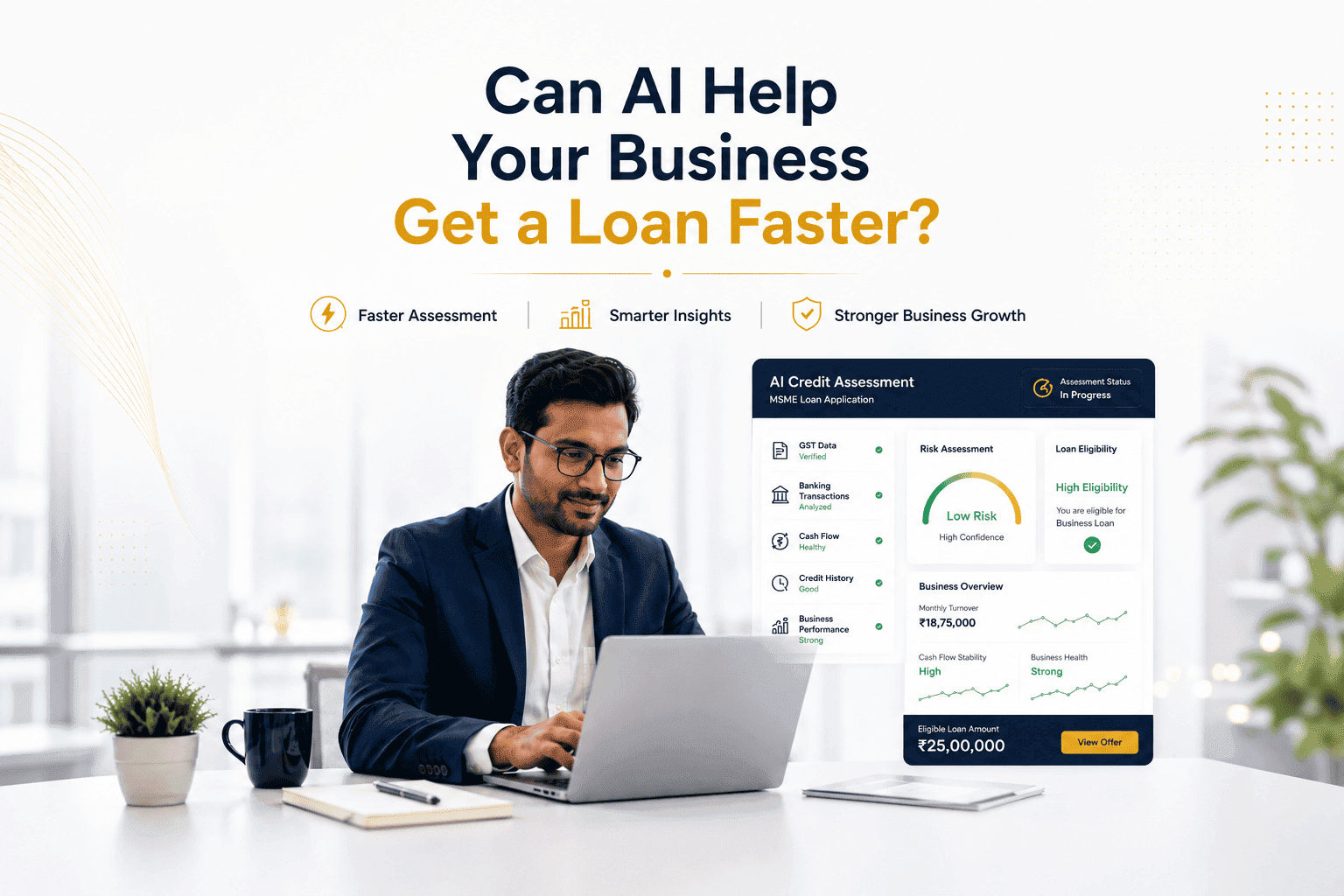
For many MSME owners, applying for a business loan has traditionally meant preparing financial statements, bank statements, GST records, tax documents and other paperwork before waiting for a lender to manually assess the application.
That process is changing.
Artificial intelligence, automation, APIs, account aggregation and digital credit models are allowing lenders to assess business data much faster than traditional document-heavy underwriting.
India has already moved beyond the experimental stage. Public-sector banks introduced a Credit Assessment Model (CAM) based on digitally fetched and verifiable data for MSME lending in 2025. The model uses digital information to support automated loan appraisal and model-based limit assessment.
By December 31, 2025, public-sector banks had sanctioned more than 3.96 lakh MSME loan applications worth over ₹52,300 crore under digital credit underwriting programmes, according to the Ministry of Finance.
But there is an important distinction:
AI can make credit assessment faster. It does not automatically make every business eligible for a loan.
The technology can process information quickly, identify patterns and reduce manual work. The underlying financial health of the business still matters.
For MSME owners, this creates a new question:
What does an AI-enabled lender actually see when it evaluates my business?
What Is AI-Powered Credit Assessment?
Traditional underwriting often relies heavily on documents submitted by the borrower.
A credit analyst may manually review:
Financial statements
GST returns
Bank statements
Income-tax returns
Credit reports
Existing loan obligations
Business information
Promoter details
Technology-enabled underwriting can automate significant parts of this process.
Instead of relying entirely on manually submitted documents, systems can retrieve and analyze digitally available information through APIs and other regulated data-sharing mechanisms.
The government's description of the new MSME Credit Assessment Model includes digital verification of GST data, bank-statement analysis through account aggregators, ITR verification, credit bureau information, fraud checks and other digital data points.
This creates a more connected view of a business.
Instead of asking only:
"What documents did the borrower submit?"
A technology-enabled system can also ask:
"What does the borrower's actual financial and transactional behavior indicate?"
Does AI Actually Approve the Loan?
Not necessarily.
This is one of the biggest misconceptions about AI-based lending.
AI and automated decisioning can support:
Data collection
Data verification
Financial analysis
Risk scoring
Fraud detection
Eligibility assessment
Loan-limit estimation
Application routing
Exception identification
But lending decisions remain subject to the lender's credit policy, regulatory requirements and risk-management framework.
The 2025 MSME Credit Assessment Model was specifically designed to automate and standardize appraisal using objective data and bank-specific credit rules. Government information states that the model does not fundamentally change the basic eligibility criteria established through applicable regulatory and bank policies.
In other words:
Automation changes how quickly and consistently information can be assessed. It does not eliminate credit risk.
Why AI Can Make Business Loan Processing Faster
Traditional underwriting can require multiple manual steps.
A typical process may look like:
Application → Document Collection → Verification → Financial Analysis → Credit Review → Queries → Reassessment → Decision
Technology can compress several of these steps.
A digitally enabled process may look more like:
Application → Digital Data Retrieval → Automated Verification → Credit Assessment → Decision / Human Review
The difference becomes particularly significant when information is already available digitally.
The government reported that its new MSME credit assessment model can significantly reduce turnaround time compared with manual methods, with eligible bank loans under the model being decided within a maximum of up to one day in the stated implementation framework.
That does not mean every MSME loan will be approved within one day.
It means that automated processing can substantially reduce the time required for certain eligible applications.
What Data Can AI Evaluate During MSME Lending?
The most important development in AI-enabled lending is not simply artificial intelligence.
It is data availability.
When reliable business data exists digitally, technology can analyze it at scale.
Depending on the lender and product, the assessment may involve several categories.
1. Banking Transactions
Banking data can reveal the actual movement of money through a business.
Systems may analyze:
Customer receipts
Supplier payments
Monthly credits
Account balances
EMI payments
Cheque returns
Cash-flow patterns
Transaction consistency
This can provide insight into whether reported business activity aligns with actual banking behavior.
2. GST Data
GST information can help lenders understand:
Sales trends
Monthly turnover
Business continuity
Seasonal patterns
Filing behavior
Reported business activity
For example, a company reporting ₹10 crore of annual turnover should generally have banking and tax records that provide a credible explanation for that level of activity.
Technology makes these comparisons faster.
3. Income-Tax Information
ITR data can help verify:
Reported income
Business revenue
Profitability
Tax compliance
Historical financial performance
This reduces dependence on manually reviewing individual documents.
4. Credit Bureau Data
Credit information can help identify:
Existing loans
Repayment history
Overdue accounts
Credit utilization
Recent borrowing
Previous defaults
A business seeking additional borrowing cannot be evaluated properly without understanding its existing credit obligations.
5. Business and KYC Information
Digital verification can also confirm information about:
Business identity
PAN
GST registration
Promoter identity
Contact details
Business continuity
This helps reduce errors and potential fraud.
What Does an AI Credit Model Actually Look For?
AI does not simply look at whether a company has "good" or "bad" financial statements.
A credit model can evaluate patterns across multiple variables.
For example:
Revenue Pattern
Is revenue:
Growing?
Stable?
Declining?
Highly seasonal?
Concentrated in a few months?
Cash Flow Pattern
Does money consistently enter the business?
Are there long periods of weak cash flow?
Does the business have sufficient liquidity to service debt?
Repayment Behavior
Are existing loans being paid on time?
Are there repeated payment failures?
Financial Consistency
Do GST filings, banking activity and financial statements tell a broadly consistent story?
Business Stability
How long has the business operated?
How predictable are its receipts?
Existing Leverage
How much debt does the business already carry?
Risk Signals
Are there unusual transactions, significant discrepancies or indicators requiring additional investigation?
The advantage of technology is that these relationships can be assessed much faster than through purely manual review.
Traditional Underwriting vs AI-Enabled Lending
The difference can be summarized as follows:
Factor | Traditional Underwriting | Technology-Enabled Underwriting |
|---|---|---|
Data collection | Primarily document-driven | Digital and document-assisted |
Verification | Often manual | Increasingly automated |
Bank analysis | Analyst reviews statements | Automated transaction analysis |
GST verification | Document/API-assisted | API and digital-data enabled |
Credit assessment | Analyst-led | Model-assisted |
Fraud checks | Manual + system checks | Automated pattern detection + checks |
Processing time | Can be longer | Can be significantly faster |
Human involvement | High | Lower for straightforward cases |
Complex cases | Manual assessment | Usually escalated for deeper review |
Decision consistency | Depends partly on process | Greater standardization possible |
The important point is not that one system completely replaces the other.
The future is more likely to be technology-assisted underwriting with human oversight where necessary.
Does Faster Assessment Mean Easier Loan Approval?
No.
This distinction matters for every MSME owner.
Suppose two businesses apply for the same ₹50 lakh loan.
Business A
Stable turnover
Healthy banking transactions
Consistent GST filings
Strong repayment history
Manageable existing debt
Business B
Irregular bank credits
Weak profitability
Existing overdue loans
Significant debt burden
Inconsistent financial records
An automated system may evaluate both businesses quickly.
But faster assessment does not mean both businesses will receive approval.
The technology improves the speed of evaluation.
It does not remove the underlying financial risk.
A Realistic Example: How AI Could Change a Loan Application
Consider an MSME manufacturer seeking ₹75 lakh for machinery and working capital.
Under a traditional process, the lender might request financial statements, GST records, bank statements, ITRs and other documents.
An analyst then manually verifies the information and calculates financial ratios.
If a discrepancy appears, the borrower may be asked for additional documents.
In a technology-enabled process, digitally available information can potentially be retrieved and analyzed automatically.
The system may identify:
₹8 crore annual turnover
Stable GST sales
Consistent bank credits
Existing loan repayments
Healthy repayment history
Sufficient estimated cash-flow capacity
The application may then move through the lender's automated credit rules much faster.
If everything fits the lender's criteria, the application may qualify for a quicker decision.
If something does not fit, it may be sent for additional review.
This is where human judgment remains valuable.
Where Human Judgment Still Matters
AI is powerful at processing structured data.
Business lending, however, is not always completely structured.
Consider a company that experienced a temporary revenue decline because of:
A factory relocation
A major customer acquisition cost
A temporary supply-chain disruption
Expansion into a new market
A one-time capital expenditure
An algorithm may identify the decline.
A human credit professional can investigate why it happened.
That distinction can matter.
Humans can evaluate context
A credit professional can ask:
Is the decline temporary?
Has the business recovered?
Is the customer concentration strategic or dangerous?
Is the new investment likely to improve future cash flow?
Does the promoter have sufficient industry experience?
Is there a credible explanation for an unusual transaction?
AI can identify the pattern.
Human judgment can help interpret the context.
What Happens When the Data Is Wrong?
This is one of the biggest risks in automated credit assessment.
AI is only as useful as the information it receives.
Imagine a business has:
Incorrect GST information
An outdated bank record
A credit-report error
Misclassified transactions
Incomplete financial information
An automated system may interpret incorrect information as a genuine risk signal.
That can affect the outcome.
Therefore, digital lending does not eliminate the borrower's responsibility.
It makes data accuracy more important.
Borrower Responsibility Is Becoming More Important
In a traditional process, a borrower may physically submit documents and explain discrepancies to an analyst.
In a highly automated process, the initial assessment can happen before a person reviews every detail.
Business owners should therefore maintain:
Accurate GST filings
Updated KYC information
Correct financial statements
Clean banking records
Timely tax filings
Accurate loan disclosures
Correct credit information
The cleaner the underlying data, the easier it becomes for technology to understand the business correctly.
Can AI Help Businesses With Thin Credit Histories?
Potentially, yes.
This is one of the most interesting possibilities of digital lending.
Traditional underwriting may struggle when a business has limited formal financial history.
But a digitally connected ecosystem can potentially provide additional signals from transaction and compliance data.
For example, a business may have:
Consistent digital payments
Regular GST filings
Stable bank transactions
Strong invoice activity
Reliable customer receipts
These signals can provide additional information about business activity.
However, additional data does not automatically guarantee approval.
The lender still needs sufficient evidence that the borrower can repay the proposed facility.
AI Could Be Particularly Important for MSMEs
Large corporations generally have extensive financial histories and dedicated finance teams.
Smaller businesses often have less structured financial information.
That creates an opportunity for digital underwriting.
If reliable data can be retrieved automatically, lenders can potentially spend less time collecting basic information and more time evaluating actual credit risk.
India's move toward digital-footprint-based MSME credit assessment reflects this broader shift. The government's model is designed for both existing-to-bank and new-to-bank MSME borrowers, using digitally fetched and verifiable information for automated appraisal.
What AI-Based Lending Does Not Guarantee
MSME owners should avoid several assumptions.
AI does not guarantee approval
A strong digital profile does not override lending criteria.
AI does not guarantee the lowest interest rate
Pricing depends on the lender, product, risk profile and other terms.
AI does not eliminate documentation in every case
Complex or higher-risk applications may still require additional documents and human review.
AI does not eliminate underwriting risk
It helps lenders process information more efficiently.
AI does not replace financial discipline
Poor banking behavior, weak repayment capacity or inaccurate records can still affect eligibility.
How MSMEs Can Prepare for AI-Enabled Lending
The best strategy is surprisingly simple:
Keep your digital financial footprint clean.
Maintain accurate GST records
Make sure reported turnover is accurate and filings are timely.
Keep business banking organized
Use business accounts consistently and avoid unnecessary mixing of personal and business transactions.
Monitor your credit profile
Check for errors, overdue accounts and outdated information.
Maintain proper financial statements
Your financial records should accurately reflect the business.
Keep borrowing transparent
Disclose existing liabilities accurately.
Build predictable cash flows
Stable customer receipts and disciplined expense management can strengthen the overall financial profile.
Maintain digital records
Invoices, payments, tax information and financial documents should be properly organized.
What Tech-Aware MSME Owners Should Expect in the Future
The direction of lending is increasingly toward:
More data → More automation → Faster assessment → More standardized decisions
But the future is unlikely to be completely machine-only.
A more realistic model is:
Digital data + automated analysis + lender credit policy + human judgment
Technology handles repetitive information processing.
Credit professionals handle exceptions, complex cases and contextual judgment.
This combination can make lending more efficient without pretending that every business can be reduced to a single algorithmic score.
Is AI the Future of Business Lending in India?
The evidence suggests that digital credit assessment is already becoming part of India's MSME lending infrastructure rather than remaining a purely experimental concept.
Public-sector banks launched their digital-footprint-based MSME Credit Assessment Model in 2025, and official data shows substantial adoption through 2025.
The broader ecosystem also includes digital platforms, account aggregation, GST data, credit information, digital payments and automated verification.
This creates a fundamentally different lending environment.
Instead of asking borrowers to prove every aspect of their business through disconnected paperwork, lenders can increasingly analyze multiple digital signals together.
For a financially disciplined MSME, that can mean less paperwork and faster decisions.
For a business with inconsistent records, however, digital underwriting may expose weaknesses faster.
That is perhaps the most important lesson.
Technology does not hide financial problems. It can make them easier to identify.
The Bottom Line
AI can help businesses get a loan assessed faster.
It can automate data collection, verify information, analyze transactions, identify risk patterns and accelerate straightforward credit decisions.
India's MSME lending ecosystem is already moving in this direction, with public-sector banks using digital-footprint-based credit assessment models to automate parts of loan appraisal.
But faster assessment should not be confused with automatic approval.
The fundamentals still matter:
Revenue
Profitability
Cash flow
GST compliance
Banking behavior
Credit history
Existing liabilities
Business stability
Repayment capacity
For MSME owners, the best preparation for the future of digital lending is not learning how to "beat" an AI system.
It is maintaining accurate, consistent and verifiable financial records.
When the data tells a credible story, technology can help lenders understand that story faster.