

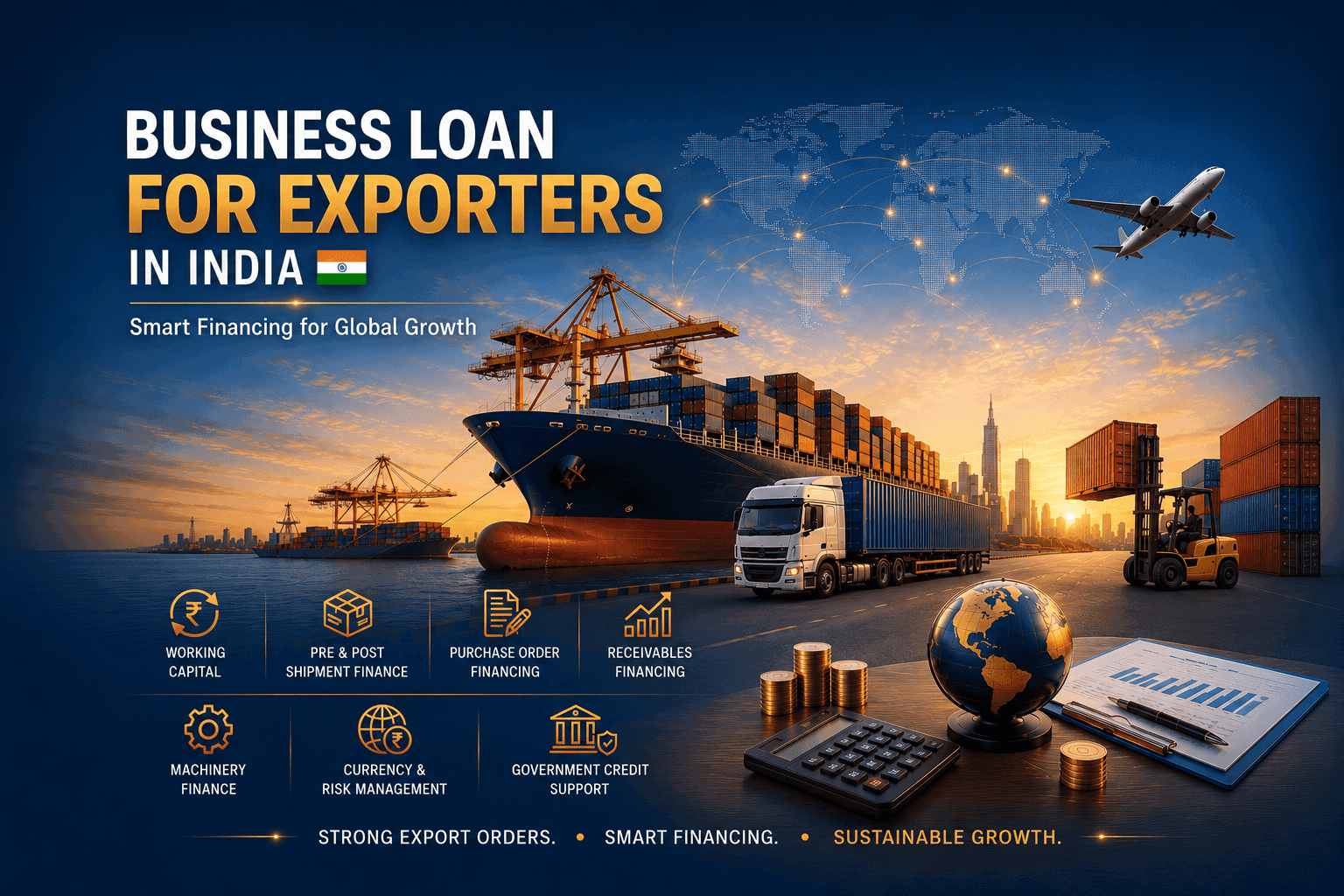
Export businesses can look financially strong on paper and still face a serious shortage of working capital.
An exporter may have confirmed international orders, established buyers, healthy sales and good future prospects, yet struggle to pay suppliers, purchase raw materials, manufacture goods, arrange packaging, cover freight costs or wait for overseas customers to make payment.
The reason is simple: export revenue and export cash flow do not arrive at the same time.
This timing gap becomes more significant when an Indian MSME starts accepting larger export orders. A ₹1 crore order, for example, may require substantial spending weeks or months before the exporter receives the corresponding payment.
That is why financing for exporters should not be approached like a conventional domestic business loan. The right facility needs to match the export cycle—from purchase of raw materials to shipment and finally realization of overseas receivables.
India's policy environment has also placed greater emphasis on improving MSME access to capital and supporting exporters. The Union Budget 2025–26 announced enhanced credit-guarantee support, including a provision for well-run exporter MSMEs for term loans up to ₹20 crore. The government's Export Promotion Mission has subsequently been structured to improve access to trade finance through tools including interest subvention, export factoring, collateral guarantees and credit support.
For manufacturers, merchant exporters, suppliers to exporters and businesses entering international markets, the key question is therefore not simply
How much business loan can I get?
It is:
Which financing structure will allow me to execute export orders without creating a cash-flow problem?
Why Exporters Often Need More Working Capital
Domestic businesses typically receive payment according to their sales cycle. Exporters can have a much longer cash-conversion cycle.
Consider a manufacturer that receives a confirmed overseas purchase order worth ₹50 lakh.
Before the shipment generates revenue, the company may need to pay for:
Raw materials
Labour and manufacturing
Packaging
Quality testing
Transportation
Customs and documentation
Freight and insurance
Port-related expenses
Other operating costs
The buyer may then pay 30, 60 or 90 days after shipment—or according to another agreed payment structure.
The exporter has therefore spent money before collecting the sale proceeds.
This creates a financing requirement even when the underlying order is commercially attractive.
A simple example
Suppose an exporter receives a ₹50 lakh order.
The estimated cost of producing and shipping the order is ₹35 lakh.
The exporter needs ₹35 lakh during production and shipment, but the ₹50 lakh sales proceeds may not arrive immediately.
If the business has only ₹15 lakh available internally, there is a potential ₹20 lakh working-capital gap.
The problem is not lack of business.
The problem is timing.
This distinction is critical when choosing export finance.
How Export Financing Works Across the Order Cycle
Export financing can broadly be divided into different stages.
Export stage | Typical requirement | Possible financing structure |
|---|---|---|
Order received | Raw materials and production | Pre-shipment finance / working capital |
Production | Inventory and operating expenses | Cash credit / working capital |
Shipment | Freight and related costs | Export credit / working capital |
Goods shipped | Waiting for buyer payment | Post-shipment finance |
Invoice outstanding | Immediate liquidity | Receivables or export factoring |
Capacity expansion | Plant and equipment | Machinery / term loan |
Larger export contract | Multiple funding requirements | Structured combination of facilities |
The objective is to avoid using one expensive, inflexible loan for every stage.
A well-structured exporter may use different facilities for different parts of the cash cycle.
Pre-Shipment Finance: Funding the Order Before Dispatch
Pre-shipment finance is designed to fund expenses incurred before goods are shipped to the overseas buyer.
It is particularly relevant for manufacturers and exporters who receive confirmed purchase orders but need capital to execute them.
RBI's export-credit framework recognises pre-shipment export credit, including packing credit, as a financing mechanism for exporters.
What can pre-shipment funding support?
Depending on the facility and lender, funding may support expenses such as:
Purchase of raw materials
Manufacturing costs
Processing
Packaging
Labour and related production expenses
Other eligible expenses connected with fulfilling the export order
For example, a textile exporter receives an order from an overseas retailer but needs ₹30 lakh to purchase fabric, manufacture the garments and prepare the shipment.
Instead of waiting until the buyer pays, appropriate pre-shipment finance can provide liquidity during the production cycle.
Why it matters
Without adequate pre-shipment funding, an exporter may have to:
Delay production
Reject larger orders
Ask customers for additional advances
Use expensive unsecured borrowing
Depend heavily on personal funds
Stretch supplier payments
A business can therefore lose profitable international opportunities simply because it cannot finance the period between order confirmation and shipment.
Post-Shipment Finance: Funding the Waiting Period
The cash-flow challenge does not necessarily disappear after the goods leave India.
The exporter may have already completed production and shipment, but the buyer could still have several weeks or months to make payment.
That is where post-shipment finance becomes relevant.
Post-shipment credit provides financing after goods have been shipped and while the exporter is waiting for payment from the overseas buyer.
RBI's export-credit framework specifically provides for post-shipment advances and financing against export-related receivables in eligible circumstances.
Example
An engineering exporter ships goods worth ₹80 lakh under agreed payment terms of 90 days.
The exporter has already incurred the production and shipment costs.
However, the ₹80 lakh receivable remains outstanding for three months.
If the business immediately needs money to purchase materials for its next order, waiting 90 days could restrict growth.
Post-shipment financing can potentially convert part of that future receivable into current liquidity, subject to the lender's assessment and applicable documentation.
This is particularly useful for exporters experiencing rapid growth.
Purchase-Order Funding for Exporters
A confirmed purchase order can demonstrate future business, but it does not automatically create cash in the bank.
Purchase-order funding attempts to bridge that gap.
The lender evaluates the order, buyer, exporter, transaction structure, margins, repayment source and overall credit profile before determining whether financing can be provided.
For exporters, the quality of the overseas buyer can be particularly relevant.
A purchase order from an established international company with clear payment terms may provide a stronger financing case than an informal or poorly documented order from an unknown counterparty.
What lenders may examine
Depending on the financing structure, lenders may assess:
Purchase order or export contract
Buyer details
Historical relationship with the buyer
Previous export transactions
Expected order margin
Production capacity
Bank statements
GST records
Income-tax returns
Existing borrowing
Export turnover
Shipping history
Receivables ageing
Credit history
Promoter profile
Banking conduct
The important point is that an export order is evidence of potential revenue, not the same thing as realised revenue.
A lender still needs to understand how the order will be executed and repaid.
Receivables Financing: When Sales Are Locked Up in Invoices
Exporters can experience another form of working-capital pressure when invoices remain unpaid.
Imagine an exporter with ₹1.5 crore of outstanding export receivables.
The business may appear successful because the sales have already been booked.
But if customers are paying after 60 or 90 days, the company cannot use those receivables immediately to purchase inventory or fulfil another order.
Receivables financing can help businesses unlock liquidity from eligible invoices.
Export factoring
Export factoring is one potential structure.
The financing provider evaluates eligible receivables and may provide funding against them, depending on the arrangement, buyer risk and other conditions.
The government's Export Promotion Mission specifically includes export factoring among the tools intended to improve access to trade finance for MSME exporters.
ECGC also provides credit-risk protection frameworks connected with export receivables and MSME export factoring.
When receivables financing may make sense
It can be useful when:
Sales are growing faster than collections
Buyers have longer payment terms
The business has reliable overseas customers
Existing working-capital limits are insufficient
The company needs liquidity for new orders
The primary problem is delayed realization rather than lack of demand
However, businesses should compare the total cost, eligibility requirements, recourse structure and documentation before selecting a receivables-based facility.
Currency Risk Can Change the Cash-Flow Equation
Exporters also face a financing issue that domestic businesses usually do not: foreign-exchange movement.
Suppose an Indian exporter signs a contract for USD 100,000.
The company estimates its costs based on the exchange rate available when the order is accepted.
But if the rupee strengthens before the export proceeds are realised, the amount received in INR can be lower than originally expected.
Conversely, currency movements can sometimes work in the exporter's favour.
The important issue is that the business should not assume the exchange rate will remain unchanged throughout the order cycle.
Currency-related risks include:
Exchange-rate fluctuations
Mismatch between foreign-currency revenue and rupee expenses
Longer receivable periods
Currency conversion costs
Changes in import costs for imported raw materials
Foreign-currency borrowing exposure
For businesses with substantial export turnover, currency-risk management should therefore be considered alongside financing.
A company that borrows in one currency while generating cash flows in another should understand the risks before choosing that structure.
Machinery Finance for Exporters
Working capital is not the only financing requirement.
An exporter receiving larger orders may need to increase production capacity.
That could require:
CNC machinery
Processing equipment
Packaging machinery
Printing equipment
Textile machinery
Food-processing equipment
Testing equipment
Automation systems
Material-handling equipment
A term loan or machinery-finance structure may be more appropriate for these requirements than using short-term working capital.
Why the distinction matters
Suppose a manufacturer needs ₹75 lakh for a new production line that will be used for five years.
Using short-term working capital for a long-life asset can create a repayment mismatch.
The company may be forced to continuously refinance a long-term investment through short-term borrowing.
A better structure can align:
Asset life → loan tenure → expected cash generation
This can make the company's overall debt structure more sustainable.
Government-Backed Credit Support for Exporter MSMEs
Government-backed credit support can play an important role in improving access to finance, but businesses should understand what these programmes actually do.
A credit guarantee generally supports the lender's credit risk; it is not the same as the government directly giving the business a loan.
Enhanced support for exporter MSMEs
The Union Budget 2025–26 announced that credit guarantee cover would be enhanced for micro and small enterprises and specifically provided for well-run exporter MSMEs for term loans up to ₹20 crore.
This is particularly relevant for established exporters looking to finance capacity expansion.
The actual availability, eligibility and structure depend on applicable guidelines and the lending institution.
CGTMSE
The Credit Guarantee Fund Trust for Micro and Small Enterprises supports eligible lending institutions by providing guarantee cover for qualifying credit facilities to micro and small enterprises.
The MSME Ministry states that the scheme can cover collateral-free credit facilities, including working capital and term loans, subject to applicable limits, conditions and lender eligibility.
The government's MSME dashboard also shows the scale of the credit-guarantee ecosystem, reporting more than ₹14.69 lakh crore in guarantee value as of June 30, 2026.
Exporters should not assume that every export loan automatically qualifies for a government guarantee. The business, facility, lender and purpose must meet the relevant requirements.
Export Promotion Mission and Trade-Finance Support
The policy environment around exports has increasingly moved toward improving the broader financing ecosystem rather than relying only on traditional bank lending.
The Export Promotion Mission is designed as an integrated framework for export support. Government material describes its NIRYAT PROTSAHAN component as addressing access to affordable trade finance through measures including interest subvention, export factoring, collateral guarantees and credit support.
This matters because export competitiveness is affected by more than the availability of a conventional business loan.
An exporter may need support across:
Working capital
Receivables
Export insurance
Trade finance
Logistics
Market access
Quality certification
International buyer acquisition
The Ministry of Commerce has also acknowledged that MSME exporters can face challenges related to financial assistance, certifications, logistics and access to foreign markets.
ECGC and Export Credit Risk
Financing an overseas order also involves buyer risk.
An international customer may delay payment or, in some situations, fail to pay.
Political and commercial risks can further complicate export receivables.
ECGC provides export credit insurance mechanisms designed to protect exporters and support banks against specified commercial and political risks. For example, its buyer-specific policies can provide cover against defined commercial and political risks, subject to policy terms and eligibility.
This can matter from a financing perspective because better-managed receivable risk can strengthen the overall export-finance structure.
However, insurance is not a substitute for credit assessment.
An exporter should still evaluate:
Buyer's financial strength
Country risk
Contract terms
Payment terms
Letter-of-credit structure
Currency exposure
Insurance coverage
Dispute provisions
Why a Confirmed Export Order Does Not Guarantee Loan Approval
One of the most common misconceptions among growing exporters is:
"I have a confirmed order, so the lender should finance it."
Not necessarily.
A purchase order answers one question:
Is there expected demand?
A lender must answer several additional questions:
Can the exporter execute the order?
Will the transaction generate enough margin?
Will the buyer pay?
How much working capital is actually required?
What existing debt does the business already carry?
How will the proposed loan be repaid?
This is why two exporters with identical order values can receive very different financing decisions.
Example
Exporter A:
₹5 crore annual turnover
Regular banking transactions
Strong buyer history
Consistent GST and tax records
Moderate existing debt
Healthy margins
Timely repayment history
Exporter B:
₹5 crore annual turnover
Large cash transactions outside banking
High existing liabilities
Irregular repayment history
Weak documentation
Concentration in one overseas buyer
Both may have a ₹1 crore export order.
Their financing profiles are not equivalent.
How Lenders Assess Exporter Loan Applications
A lender generally looks beyond turnover.
The assessment can involve several interconnected factors.
Factor | Why it matters |
|---|---|
Turnover | Indicates business scale |
Banking turnover | Shows actual movement of business funds |
Profitability | Indicates ability to absorb financing costs |
GST data | Helps validate reported business activity |
ITR and financial statements | Shows financial performance |
Export history | Demonstrates execution capability |
Buyer profile | Helps assess transaction quality |
Receivables ageing | Shows collection efficiency |
Existing liabilities | Determines current debt burden |
Credit history | Indicates repayment behaviour |
Promoter profile | Helps assess management risk |
Collateral | May influence available structures |
Order book | Indicates future revenue visibility |
Sector | Determines business-specific risk |
For exporters, cash-flow visibility can be particularly important.
A lender may want to understand the entire journey:
Order → Production → Shipment → Invoice → Buyer Payment → Loan Repayment
The stronger and more transparent this chain is, the easier it becomes to evaluate the funding requirement.
Choosing the Right Financing Structure
There is no single "best business loan" for every exporter.
The appropriate structure depends on where the cash-flow gap occurs.
If the problem is before shipment
Consider exploring:
Pre-shipment finance / working capital
Useful when money is required for production, raw materials and order execution.
If the problem is after shipment
Consider:
Post-shipment finance
Useful when goods have been shipped but payment has not yet arrived.
If confirmed orders are growing rapidly
Consider:
Purchase-order or structured working-capital finance
Useful when future business is strong but current liquidity is insufficient.
If receivables are the bottleneck
Consider:
Receivables financing or export factoring
Useful when sales have happened but cash collection is delayed.
If capacity is the bottleneck
Consider:
Machinery finance / term loan
Useful when the business needs long-term capital expenditure.
If risk is concentrated around overseas buyers
Consider:
Export credit insurance / appropriate ECGC cover
Useful for managing defined commercial and political risks.
In many cases, the optimal solution is a combination of facilities, rather than one large unsecured loan.
A Practical Funding Example
Consider an Indian engineering manufacturer with:
Annual turnover: ₹12 crore
Export turnover: ₹7 crore
New confirmed export orders: ₹3 crore
Production cost for those orders: ₹2.1 crore
Average buyer payment period: 60 days
Existing working-capital utilisation: high
New machinery requirement: ₹60 lakh
The company potentially has two different funding needs.
Requirement 1: Order execution
The ₹2.1 crore production requirement is primarily a working-capital problem.
The business could explore appropriate pre-shipment and working-capital structures.
Requirement 2: Machinery
The ₹60 lakh equipment purchase is a capital expenditure.
A term loan or machinery-finance structure may be more appropriate.
Trying to fund both requirements through one short-tenure facility could unnecessarily pressure cash flow.
The better approach is to separate:
Short-term funding → operating cycle
Long-term funding → productive assets
This is the basic principle behind effective export-finance structuring.
Common Financing Mistakes Exporters Should Avoid
1. Borrowing only after the cash shortage appears
By the time a business urgently needs money, its options may already be limited.
Funding should ideally be planned before the order reaches its peak cash requirement.
2. Treating order value as available cash
A ₹2 crore purchase order does not mean ₹2 crore is available to the company.
The business still needs to finance production and wait for realization.
3. Using long-term loans for short-term gaps
A long-term loan may be unnecessarily expensive or structurally inefficient for a temporary working-capital requirement.
4. Using working capital for permanent assets
Financing machinery entirely through short-term borrowing can create repayment pressure.
5. Ignoring receivables ageing
Growing sales can actually increase funding requirements if customers take longer to pay.
6. Ignoring currency exposure
A profitable export contract can experience margin pressure if currency movements are not considered.
7. Depending on a single buyer
A business heavily dependent on one international customer may face higher concentration risk.
8. Waiting until the order book is exhausted
Financing should be arranged before production capacity and liquidity become bottlenecks.
Documents Exporters Should Keep Ready
A well-organised documentation package can make financing discussions more efficient.
Depending on the lender and facility, exporters may need documents such as:
Business registration documents
Udyam Registration, where applicable
PAN and KYC documents
GST returns
Income-tax returns
Audited financial statements
Bank statements
Existing loan statements
Export invoices
Purchase orders
Export contracts
Shipping documents
Receivables ageing
Buyer details
Export turnover details
IEC-related documentation
Details of existing working-capital limits
Machinery quotations for term-loan requirements
The exact list varies by lender and financing product.
The stronger the documentation, the easier it is to demonstrate the relationship between orders, costs, receivables and repayment capacity.
Exporters Should Calculate the Funding Gap Before Accepting an Order
Before accepting a large international order, management should estimate the maximum cash requirement.
A simple framework is:
Funding Gap = Peak Cash Outflow − Available Internal Liquidity
But the calculation should go beyond production cost.
Consider:
Raw materials + manufacturing + packaging + logistics + duties/taxes where applicable + freight + operating expenses − supplier credit − customer advance − available working capital
Then estimate how long the money will remain locked in the cycle.
A useful pre-order checklist
Before accepting a major export order, ask:
How much cash is required before shipment?
How much can suppliers finance?
Is the buyer providing an advance?
When will the goods be shipped?
When will the invoice be paid?
What happens if payment is delayed by 30 days?
What happens if the currency moves against the business?
Is export credit insurance appropriate?
What existing borrowing is already being utilised?
Can the business finance the next order while waiting for this payment?
If the answers reveal a liquidity gap, financing should be arranged before the order becomes operationally urgent.
Who Can Benefit from Export-Focused Business Financing?
Export finance is not limited to large established exporters.
Manufacturers
Manufacturers may need funding to purchase raw materials, operate production lines and increase capacity.
Merchant exporters
Merchant exporters may need liquidity to procure products from domestic suppliers before shipment to international buyers.
Suppliers to exporters
A company may not export directly but can still experience export-linked working-capital pressure when supplying goods to an exporter.
First-time exporters
Businesses entering international markets may need funding for production, certification, packaging, logistics and market development.
The financing strategy should therefore be based on the cash-flow model, not simply on whether the business holds an export label.
How to Prepare for an Export Business Loan
A stronger application begins with a clear financial story.
Instead of simply saying:
We need ₹1 crore for our export business.
A business should be able to explain:
What orders have been received?
Who are the buyers?
How much will each order cost to execute?
How much funding is required?
When will the money be used?
When will the goods be shipped?
When will payment be received?
What existing limits are available?
What will repay the new facility?
What happens if collections are delayed?
This transforms a loan request from a generic funding requirement into a cash-flow-backed financing proposal.
Final Takeaway: Fund the Export Cycle, Not Just the Business
Export growth can create a paradox.
The more orders a business wins, the more working capital it may need.
A company can therefore be profitable, have strong international buyers and maintain a healthy order book while still facing a serious liquidity shortage.
The solution is not always a larger generic business loan.
It may involve combining:
Pre-shipment working capital
Post-shipment finance
Purchase-order funding
Receivables financing
Export factoring
Machinery finance
Credit guarantees
Export credit insurance
Appropriate currency-risk management
The right structure depends on where money gets locked up in the export cycle.
For Indian MSMEs planning to accept larger international orders, the most important step is to calculate the peak funding requirement before committing to the order.
A confirmed export order can create growth—but only if the business has enough liquidity to manufacture, ship, wait for payment and continue operating while the receivable is outstanding.
In short:
Strong export orders create opportunity.
Smart financing turns that opportunity into sustainable growth.