

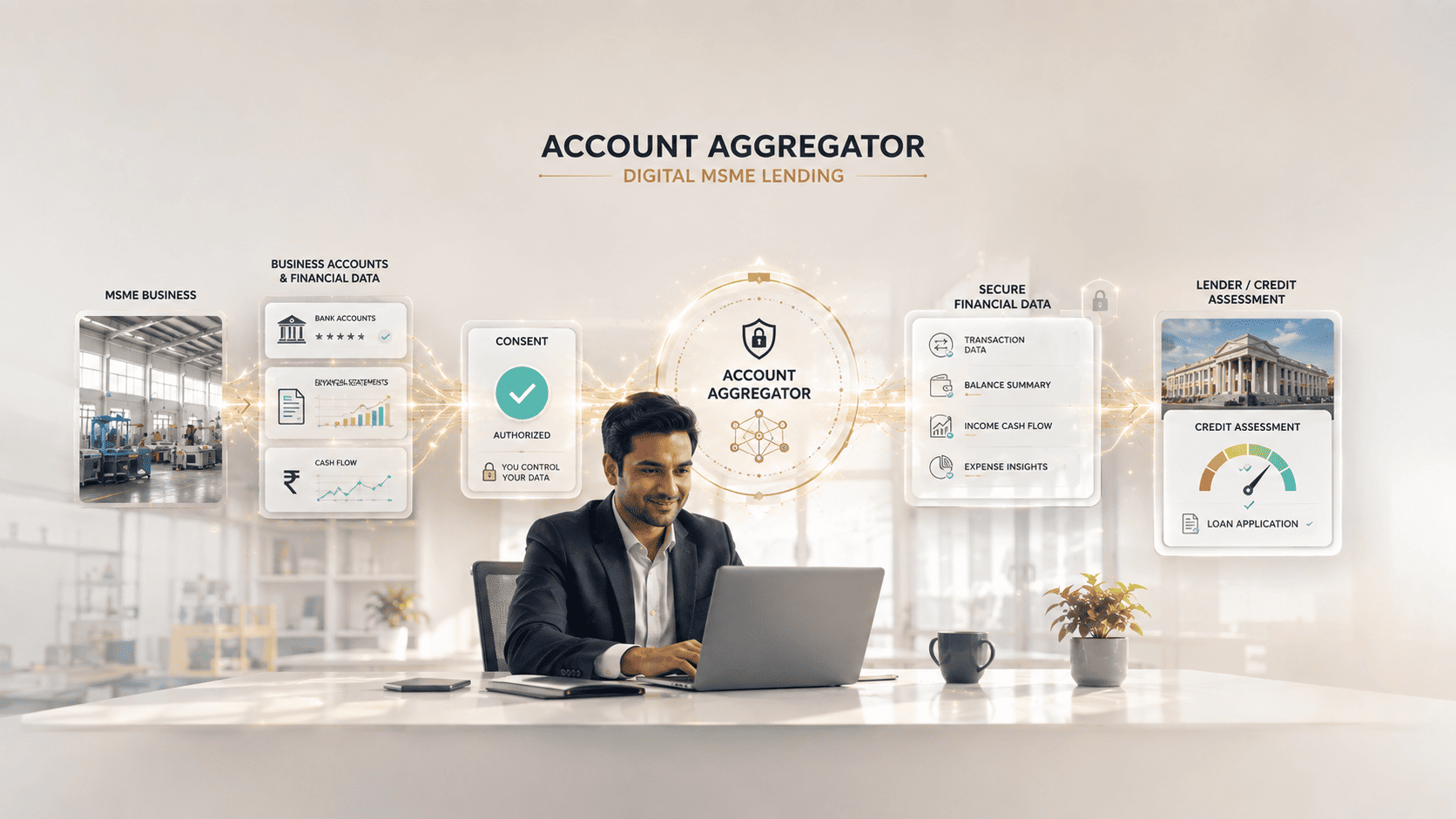
For many MSMEs in India, applying for a business loan can feel less like a financial decision and more like a documentation exercise.
Bank statements have to be collected. Financial records need to be organized. Supporting documents may have to be uploaded or submitted. If a business maintains accounts with multiple financial institutions, gathering everything can become even more time-consuming.
India's Account Aggregator framework is designed to change part of this process.
Instead of repeatedly collecting and submitting financial information, businesses can use a consent-based digital system to share eligible financial data with authorized financial institutions. The objective is not simply to make paperwork digital. It is to give customers greater control over how their financial information is accessed and shared.
For MSMEs, this could make business-loan applications more streamlined and help lenders evaluate a business using more timely financial information.
The Reserve Bank of India describes Account Aggregators as regulated entities that retrieve and transfer specified financial information based on customer consent. Importantly, the Account Aggregator itself is not supposed to use the information for purposes outside the service requested by the customer.
That distinction matters.
Account Aggregator is not a new type of loan. It is a financial-data-sharing infrastructure that can potentially make lending and other financial services more efficient.
What Is an Account Aggregator?
An Account Aggregator (AA) is a regulated financial-data intermediary that enables customers to share their financial information digitally with authorized institutions after giving explicit consent.
Think of it as a secure digital pipeline.
Instead of a borrower manually downloading financial records from different institutions and sending them to a lender, the borrower can authorize the relevant information to be retrieved through the Account Aggregator framework.
The basic ecosystem involves four parties:
Participant | What it does |
|---|---|
Customer | Owns/control the financial-data sharing decision |
Financial Information Provider (FIP) | Holds the customer's financial information |
Account Aggregator (AA) | Manages consent and facilitates secure data transfer |
Financial Information User (FIU) | Receives authorized information for a permitted purpose |
Banks and other eligible financial entities can participate as Financial Information Providers, while lenders can act as Financial Information Users where applicable.
The RBI framework requires financial information to be shared only with the customer's explicit consent. The consent mechanism specifies important details such as what information is being requested, why it is required, who will receive it, and the period for which the consent applies.
This creates an important difference from simply handing over a pile of financial documents.
The customer remains involved in deciding what information is shared and for what purpose.
Why Does Account Aggregator Matter for MSME Loans?
Traditional business lending often depends on documentation.
A lender may need to understand:
Business banking activity
Cash-flow patterns
Existing liabilities
Revenue-related information
Financial assets
Tax-related information where supported by the ecosystem
Other relevant financial information permitted under the framework
The problem is not necessarily that these documents are unreasonable.
The problem is that collecting them manually can create friction.
A business owner may have to locate statements, download files from different banking portals, check date ranges, rename documents and upload them individually. Missing or outdated information can create another round of requests.
Account Aggregator can potentially reduce some of this friction by enabling standardized, consent-based digital information flows.
The RBI itself has highlighted the potential of the framework for small borrowers, including MSMEs, particularly in connection with cash-flow-based lending and the inclusion of GSTN in the ecosystem.
That could become increasingly important as lenders move toward more digital forms of credit assessment.
How Does Account Aggregator Work During a Loan Application?
The process can be understood through a simple example.
Imagine Meera runs a wholesale distribution business and wants working-capital finance.
Her business has a bank account containing several months of transaction history. The lender needs relevant financial information to assess the application.
Instead of relying entirely on manually submitted statements, a digital lending process may allow Meera to authorize the sharing of eligible information through an Account Aggregator.
Step 1: The lender requests financial information
The lender identifies the information required for the loan assessment.
The request should not simply mean "give me everything."
The Account Aggregator consent framework is designed around specific information, purpose, recipient and validity parameters.
Step 2: The borrower reviews the consent request
Meera sees what information is being requested, why it is required and who will receive it.
This is one of the most important features of the system.
The borrower is not supposed to provide blanket permission for unrestricted use of financial information.
Step 3: The borrower gives explicit consent
Once the borrower approves the request, the consent is electronically recorded.
The RBI framework requires consent to be capable of being logged, audited and verified.
Step 4: The information provider verifies the request
The institution holding the information verifies the consent and the relevant authorization before sharing the information.
The information is then digitally transmitted through the framework.
Step 5: The lender receives the authorized information
The lender receives the information according to the terms of the consent.
This can reduce the need for the borrower to repeatedly download and upload documents manually.
Step 6: The information can support credit assessment
The lender can use the authorized information as part of its credit evaluation.
This does not mean that Account Aggregator automatically approves a loan.
The lender still decides whether the business qualifies based on its own underwriting policies, risk assessment, eligibility criteria and regulatory requirements.
What Financial Information Can Be Shared?
Account Aggregator is broader than simply "sharing a bank statement."
The framework supports specified categories of financial information held by participating financial institutions.
Depending on the ecosystem participant and applicable permissions, financial information can include information associated with financial assets such as:
Bank accounts
Deposits
Certain investment-related information
Insurance-related information
Pension-related information
Other eligible financial information supported by participating institutions
GST-related information through GSTN participation in the ecosystem
The exact information available depends on the participating Financial Information Providers, the type of account or asset, the applicable framework and the purpose for which information is requested.
This is important because businesses should not assume that every financial record automatically becomes available through Account Aggregator.
The framework is permission-based and ecosystem-dependent.
Account Aggregator vs. Physical Bank Statements
The biggest practical difference is the method of information collection.
Traditional document collection | Account Aggregator-based sharing |
|---|---|
Business downloads statements manually | Information can be retrieved digitally |
Multiple files may need to be collected | Authorized information can flow through APIs |
Documents may be uploaded separately | Data can be transmitted electronically |
Greater dependence on document handling | Greater dependence on standardized digital infrastructure |
Repeated requests can create delays | Potentially faster information retrieval |
Older documents may be submitted accidentally | Information can be retrieved from the participating source |
Borrower manages more of the paperwork | Consent manages the sharing process |
This does not mean physical statements will disappear.
Lenders may still request specific documents depending on the loan product, borrower profile, regulatory requirements or internal credit policy.
The real change is that financial-data sharing can become more digital, standardized and consent-driven.
Can Account Aggregator Make Business Loans Faster?
Potentially, yes—but it is important not to confuse faster data access with guaranteed faster loan approval.
The RBI has stated that Account Aggregator can substantially reduce loan-processing time and can allow digitally transmitted financial information to support lending and other financial services.
The potential time savings come from reducing manual information collection.
Consider two scenarios.
Traditional process
A lender requests six months of bank statements.
The business owner:
Logs into the bank portal.
Downloads the statements.
Checks whether the correct period is covered.
Combines or renames files.
Uploads them.
Responds if the lender requests another document.
If the business uses multiple financial institutions, the process can become more complicated.
Digital data-sharing process
The borrower receives a consent request.
The borrower reviews the purpose and information requested, authorizes sharing, and the relevant data can then be transmitted through the Account Aggregator framework.
The lender can receive information digitally instead of depending entirely on manually collected files.
The result can be a smoother application experience.
But approval still depends on the lender's underwriting process.
Why Better Data Could Matter for MSME Credit Assessment
One of the larger opportunities is not merely document reduction.
It is better visibility into business cash flows.
Traditional credit assessment can sometimes rely heavily on static documents.
Digital financial information can potentially provide a more structured view of financial activity.
For example, a lender may be able to evaluate patterns such as:
Regular business receipts
Payment cycles
Cash-flow consistency
Existing repayment obligations
Account balances
Financial commitments
Business transaction patterns
This can be particularly relevant for MSMEs because a small business may have a perfectly legitimate operating history without having the same depth of documentation as a large corporation.
A richer financial-data environment could support more nuanced credit assessment.
However, there is an important distinction:
More data does not automatically mean better lending decisions.
The quality of the underwriting model still matters.
A lender must determine which information is relevant, how it should be interpreted and how it fits within its credit policy.
Where AI and Account Aggregator Could Meet
This is where the future of digital MSME lending becomes particularly interesting.
Account Aggregator provides a standardized mechanism for authorized financial-data sharing.
AI and automated analytics can potentially help lenders analyze large volumes of structured information.
Together, these technologies could support more efficient credit assessment.
For example, an automated underwriting system could potentially analyze financial patterns and identify:
Changes in cash-flow consistency
Revenue trends
Existing debt obligations
Unusual transaction patterns
Repayment capacity indicators
Seasonal business cycles
The objective should not be to replace human judgment with an algorithm.
Instead, digital data and analytics can help lenders make decisions using more structured information.
This could eventually move lending away from a documentation-heavy model toward a data-enabled credit assessment model.
For MSMEs, that could mean a future in which financial performance is easier to communicate to lenders without repeatedly assembling the same paperwork.
What Are the Benefits for MSME Owners?
1. Less manual documentation
Businesses may spend less time downloading, organizing and uploading financial statements.
2. Potentially faster information retrieval
The RBI notes that the Account Aggregator framework can substantially reduce loan-processing time.
3. Greater control over financial-data sharing
Consent is central to the framework.
The borrower can see what information is requested and for what purpose.
4. Better digital financial records
Instead of relying entirely on paper or static documents, businesses can participate in a more connected financial ecosystem.
5. Potentially better cash-flow-based assessment
MSMEs whose financial activity provides a useful picture of their repayment capacity may benefit as lenders develop more sophisticated cash-flow-based underwriting.
6. Easier access to multiple financial services
The framework is not limited to lending. RBI's consumer-facing information describes potential uses across lending, credit monitoring, wealth management, reconciliation and personal financial management.
What About Privacy?
Privacy is one of the most important issues to understand before using Account Aggregator.
The framework is specifically designed around consent.
Under the RBI directions:
Financial information cannot be retrieved, shared or transferred without explicit consent.
The consent specifies the nature of information requested.
The purpose of the request is specified.
The recipient can be identified.
Consent has creation and expiry details.
Customers can revoke consent.
Customers can access records of consents they have provided and the Financial Information Users with whom information has been shared.
There is another important safeguard.
The RBI directions state that an Account Aggregator should not access customer authentication credentials such as passwords or PINs used for accounts with Financial Information Providers.
The framework also requires that financial information accessed by the Account Aggregator should not reside with the Account Aggregator, subject to the regulatory framework.
In simple terms, the AA is intended to facilitate authorized data movement rather than become a warehouse of customers' financial information.
Can an MSME Revoke Consent?
Yes.
Consent is not intended to be permanent.
The RBI framework requires Account Aggregators to provide functionality for customers to revoke consent, including the ability to revoke access to parts of the information covered by the consent.
This gives businesses an important form of control.
Before approving a request, an MSME should therefore check:
What information is being requested?
Why is it required?
Who will receive it?
How long is the consent valid?
Can the consent be revoked?
Is the institution involved an authorized participant in the ecosystem?
These questions are useful regardless of how convenient the digital process appears.
Does Account Aggregator Mean a Loan Will Be Approved?
No.
This is one of the most important misconceptions to avoid.
Account Aggregator is an information-sharing mechanism, not a loan approval mechanism.
A lender may use authorized financial information as part of its assessment, but approval can still depend on factors such as:
Business financial performance
Repayment capacity
Existing obligations
Credit history
Business vintage
Loan amount
Industry risk
Banking behavior
Collateral requirements where applicable
Lender-specific policies
The purpose of Account Aggregator is to make financial information easier to share—not to guarantee a lending outcome.
What Should MSME Owners Check Before Sharing Data?
Convenience should not replace caution.
Before approving any consent request, review the request carefully.
Check the purpose
Do not approve a request without understanding why the information is required.
Check the recipient
Confirm which financial institution or authorized entity will receive the information.
Check the information scope
Understand whether the request covers one account, multiple accounts or another category of financial information.
Check the validity period
Consent should have defined parameters. Make sure you understand how long it applies.
Keep track of active consents
The ability to review consent records is an important part of the framework.
Use official channels
Do not share banking passwords, PINs or authentication credentials with people claiming they need them to "activate" Account Aggregator access.
The RBI framework specifically states that Account Aggregators should not access such customer credentials.
What Could Account Aggregator Mean for the Future of MSME Lending?
The long-term significance of Account Aggregator goes beyond eliminating paperwork.
It could help create a financial ecosystem where businesses can share verified financial information when they need a financial service, rather than repeatedly rebuilding their financial history for every institution.
Imagine an MSME applying for working capital.
Instead of preparing a large documentation package from scratch, the business could authorize relevant financial information from participating institutions. A lender could then use that information as one input into its credit assessment.
As more financial institutions participate and digital underwriting becomes more sophisticated, this could support:
Faster financial-data verification
More standardized lending processes
Greater use of cash-flow-based assessment
Potentially improved access for underserved businesses
More personalized financial products
Greater competition among financial-service providers
The RBI has described the broader objective of Account Aggregator as enabling data empowerment and improving access to financial services.
The opportunity for MSMEs is therefore not simply "less paperwork."
It is the possibility of making the business's financial history more portable, usable and digitally accessible—while keeping consent at the center.
Account Aggregator Is Not a Replacement for Financial Discipline
Digital lending infrastructure can make information easier to share.
It cannot make an unhealthy business financially healthy.
An MSME should still maintain:
Accurate accounting records
Clean banking practices
Timely tax compliance
Sensible borrowing levels
Regular repayment discipline
Clear separation between business and personal finances
Reliable cash-flow management
Account Aggregator may help a lender see the financial picture more efficiently, but the underlying financial picture still matters.
For business owners, that makes financial discipline even more valuable.
If lenders increasingly use digital financial information, businesses that maintain transparent and consistent financial records may be better positioned to demonstrate their creditworthiness.
The Bigger Shift: From Documents to Data
The evolution of MSME lending can be viewed as a progression.
Paper documents → digital documents → consent-based financial data → automated analysis
The first step digitized paperwork.
The next step can make financial information more connected and machine-readable.
That distinction could become increasingly important as lending platforms adopt automated underwriting, analytics and AI-assisted decision systems.
Account Aggregator provides part of the infrastructure required for this transition.
But the most valuable outcome will not be technology for its own sake.
It will be a lending system in which businesses can securely communicate their financial position with less friction, lenders can evaluate relevant information more efficiently, and customers retain meaningful control over their data.
For India's MSMEs, that could represent a significant change in how business finance is accessed.
Conclusion
Account Aggregator is helping build a new model for financial-data sharing in India.
For MSME borrowers, its potential value lies in reducing repetitive documentation, enabling consent-based digital information sharing and supporting lenders in evaluating financial information more efficiently.
The framework does not guarantee faster approval or better loan terms. Instead, it creates infrastructure that can make financial information easier to access and share when the customer authorizes it.
The most important principle is consent.
Business owners should understand what information is being requested, why it is required, who will receive it and how long the permission remains valid.
As India's digital financial ecosystem develops, Account Aggregator could become an important bridge between MSME financial data and smarter digital lending.
For a small business owner, the practical takeaway is straightforward: the future of business-loan documentation may involve fewer files, more secure digital data flows and greater control over how financial information is shared.